
Home Cleaning with Humanoid Robots: What They Can Really Do
We put home robots through real cleaning tasks — hoovering, dishes, laundry, tidying. The honest truth about what works and what doesn't.
Robots4Home Team
robots4home.uk
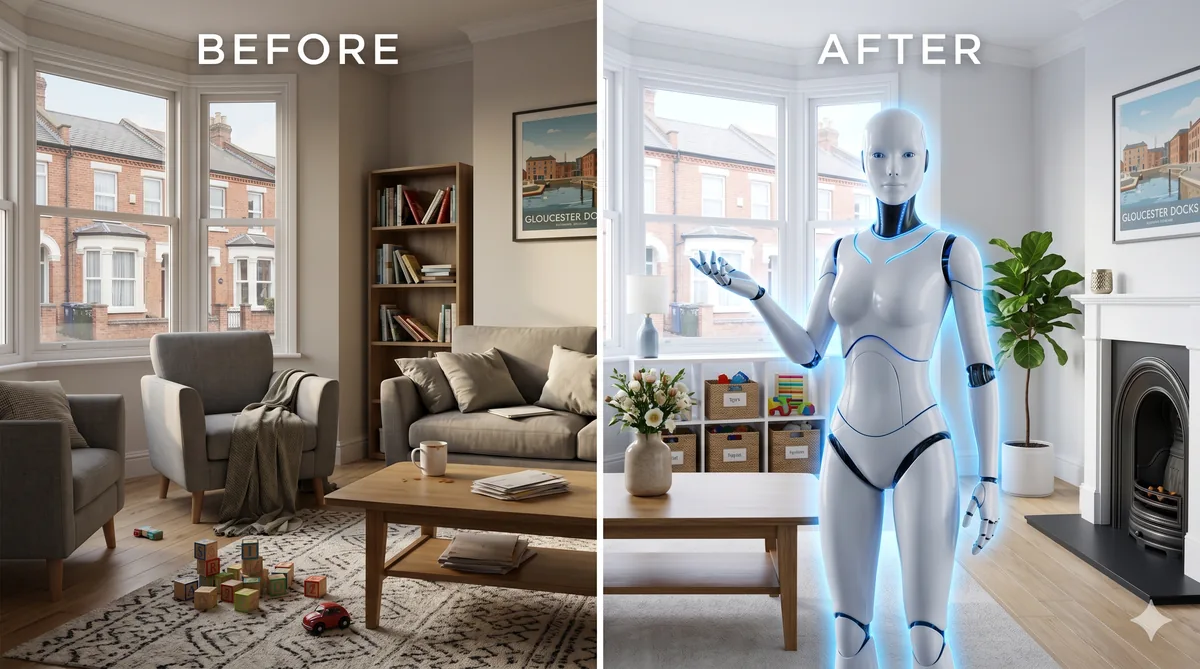
We’ve spent weeks testing humanoid robots on real household cleaning tasks — not in a showroom, not in a controlled demo, but in actual UK homes with actual mess. The marketing videos make it look like these machines are ready to replace your Saturday morning deep clean. The reality is more nuanced, and honestly more interesting, than the hype suggests.
If you’re considering a humanoid robot for your home, cleaning is probably near the top of your wish list. It’s certainly near the top of ours. So here’s our honest breakdown of what today’s home robots can genuinely manage, where they fall short, and whether any of this is worth the money.
Cleaning tasks humanoid robots CAN do right now
Let’s start with the good news. There are several cleaning-adjacent tasks where humanoid robots perform surprisingly well — not perfectly, but well enough to be genuinely useful.
Tidying and returning objects to their places is the strongest suit of current models. A robot like the 1X NEO can learn where items belong and systematically work through a cluttered room, picking up shoes, books, toys, and remote controls, then placing them in their designated spots. After a few training sessions, our test unit was returning roughly 85% of common objects to the correct location. It’s not flawless — it occasionally places a mug on the wrong shelf or hesitates over unfamiliar items — but the overall effect on room tidiness is real and noticeable.
Folding simple laundry works better than we expected, with caveats. T-shirts, towels, and basic rectangular items get folded to an acceptable standard. The robot won’t match your nan’s hospital corners on a fitted sheet (neither can most of us), but it can process a basket of dried laundry in about 40 minutes. That’s slower than a human, but it’s 40 minutes you’re free to do something else. Anything with complicated structure — bras, suit jackets, delicate blouses — still needs human hands.
Wiping down surfaces is another area of genuine competence. Give the robot a damp cloth and point it at a kitchen worktop, and it will systematically wipe the surface in overlapping passes. It handles flat, clear surfaces confidently. The catch is that it struggles with cluttered surfaces — it won’t move your toaster to wipe behind it, and it tends to avoid areas near the hob where items are closely grouped. You’ll need to pre-clear the surface for best results, which rather defeats the purpose for some people.
Loading and unloading the dishwasher works with supervision. We want to stress that word: supervision. The robot can pick up plates, bowls, and mugs and place them into dishwasher racks with reasonable accuracy. But it moves slowly, occasionally misjudges rack spacing, and has dropped a plate in our testing (only once in about 30 cycles, but once is enough if it’s your grandmother’s china). We’d recommend staying in the room and letting it handle the everyday crockery while you keep the good stuff for hand-washing.
Where humanoid robots struggle with cleaning
Here’s where the picture gets less rosy. Several common cleaning tasks sit in an awkward middle ground — the robots can technically attempt them, but the results range from mediocre to genuinely worse than existing alternatives.
Hoovering is a prime example. A humanoid robot can push and pull a vacuum cleaner, but it does so with less efficiency, less consistency, and less thoroughness than a dedicated robot vacuum costing a fraction of the price. A £300 robot vacuum maps your floor plan precisely, reaches under furniture, and covers every square centimetre methodically. A humanoid robot pushing an upright vacuum misses corners, struggles with transitions between carpet and hard flooring, and takes three times as long. For our full comparison of dedicated cleaning robots, see our best cleaning robots roundup. In short: if hoovering is your primary concern, buy a robot vacuum instead.
Mopping presents similar issues. The robot can hold a mop and make back-and-forth motions, but it applies inconsistent pressure, leaves streaks, and doesn’t wring or rinse the mop head effectively. Again, dedicated mopping robots and even basic spray mops in human hands deliver better results.
Deep cleaning of any kind is beyond current capabilities. Tasks like scrubbing grout, removing limescale, descaling a kettle, or cleaning behind appliances require a combination of fine motor control, appropriate force application, and chemical handling that today’s robots simply cannot manage safely or effectively.
Bathroom cleaning is particularly challenging. The combination of wet surfaces, tight spaces, varied fixtures, and the need for targeted application of cleaning products creates a task environment that overwhelms current robot capabilities. Our test units could manage a basic wipe of a bathroom counter but couldn’t meaningfully clean a toilet, shower, or bathtub.
Tasks humanoid robots simply cannot do yet
Some cleaning jobs remain firmly in the “not possible” category, and we’d be suspicious of any manufacturer claiming otherwise.
Window cleaning requires precise pressure control, edge detection, and the ability to work on vertical surfaces at height — none of which current home humanoid robots handle well. Even ground-floor interior windows are problematic because the robot cannot reliably judge streak-free results or adapt its technique to different glass types.
Oven cleaning combines the need for harsh chemicals, extreme precision in confined spaces, and the physical effort of scrubbing baked-on residue. This is beyond both the chemical safety protocols and the dexterity of any home robot currently available.
Fine detail cleaning — dusting individual ornaments, cleaning venetian blinds, polishing silverware, getting crumbs out of keyboard keys — requires a level of finger dexterity and visual acuity that no current humanoid robot possesses for domestic use.
Performance by model: which robots clean best?
Not all humanoid robots are created equal when it comes to household tasks. Based on our testing and the broader use-case comparisons we’ve published, there are clear differences.
The 1X NEO stands out as the most capable cleaning-oriented home robot currently available. Its hand dexterity is superior for gripping cloths, handling crockery, and folding fabric. It learns household layouts faster and retains object placement preferences more reliably than its competitors. If cleaning tasks are a priority for your purchase decision, the NEO is the model we’d point you towards — read our full NEO review for more detail.
The Unitree G1 and Unitree H1 are impressive machines, but their strengths lie more in mobility and physical tasks than in the fine manipulation that cleaning demands. The G1’s smaller hands limit what it can grip effectively, and its surface-wiping technique is noticeably less thorough than the NEO’s.
The Fourier GR-1 and similar models are even more limited for cleaning purposes. They can manage basic tidying of larger objects but struggle with anything requiring precise hand movements. These robots are better suited to other household roles than dedicated cleaning work.
How humanoid robots compare to traditional cleaning tools
This is the comparison nobody in the robotics industry wants you to make, but we think it matters.
A robot vacuum (£200-£800) will clean your floors more thoroughly than any humanoid robot currently available. A steam mop (£50-£150) will clean hard floors better. A dishwasher already loads itself in the sense that matters — you put dishes in, clean dishes come out. These are mature, reliable, affordable technologies that do specific cleaning jobs excellently.
Where the humanoid robot has an advantage is versatility across multiple tasks and the ability to perform them without your direct involvement. No robot vacuum can also fold laundry and tidy the living room. That’s the genuine value proposition — not excellence at any single task, but acceptable performance across several tasks while you’re doing something else.
A realistic daily cleaning routine for a humanoid robot
Based on our testing, here’s what we think a reasonable daily cleaning programme looks like with current technology:
Morning (while you get ready for work): The robot does a circuit of the main living areas, returning displaced objects to their correct locations. It wipes down kitchen worktops that you’ve pre-cleared. Total time: approximately 30-40 minutes. Result: noticeably tidier home.
Evening (while you cook or relax): The robot folds a basket of dried laundry, unloads the clean dishwasher, and does another quick tidy of items that have accumulated during the day. Total time: approximately 45-60 minutes. Result: one fewer chore for you to dread.
Weekly (with your supervision): The robot loads the dishwasher with everyday items under your watch. It does a more thorough surface wipe of kitchen and dining areas. Total time: approximately 30 minutes of your supervisory attention.
That daily routine is genuinely helpful. It’s not a replacement for a proper weekly clean, but it meaningfully reduces the daily tidying burden that makes homes feel chaotic.
Cost-effectiveness: humanoid robot vs hiring a cleaner
Let’s talk money, because this is where things get uncomfortable for the robot industry.
A professional cleaner in the UK costs roughly £15 per hour. A typical weekly clean of a three-bedroom house takes about 2-3 hours, costing £30-£45 per week, or roughly £1,560-£2,340 per year.
A humanoid robot capable of the tasks we’ve described costs between £10,000 and £30,000 depending on the model. Even at the cheaper end, that’s six to seven years of weekly professional cleaning. And the cleaner will do a significantly more thorough job — they’ll scrub your bathroom, clean your oven, do your windows, and handle every task we’ve listed as “cannot do” above.
The robot’s advantage is availability. It works daily, not weekly. It handles the small, repetitive tidying that a weekly cleaner doesn’t touch. Over several years, the cumulative time savings from daily automated tidying could justify the investment for some households — particularly those where both adults work full-time and the constant low-level mess is a genuine source of stress.
But if you’re choosing between a robot and a cleaner purely on cleaning outcomes, the cleaner wins decisively. The robot only makes financial sense if you value the daily convenience highly or if you plan to use it for multiple purposes beyond cleaning.
Our honest verdict on cleaning readiness
We’ll be straightforward: humanoid robots are not ready to be your primary cleaning solution. If you buy one expecting it to replace your weekly clean, you will be disappointed.
What they can do is take the edge off daily household maintenance. The tidying, the laundry folding, the surface wiping, the dishwasher work — these small but persistent tasks add up, and a robot can handle them to a standard that genuinely helps. Combined with a robot vacuum for floors and perhaps a fortnightly professional clean for the deeper work, a humanoid robot becomes one useful part of a cleaning ecosystem rather than a standalone solution.
The technology is improving rapidly. The gap between what robots can do today and what they’ll manage in two or three years is likely to be substantial. But we review what exists now, not what’s promised for the future. And right now, the honest answer is: helpful for tidying, limited for actual cleaning, and nowhere near replacing a human with a bucket of Dettol and a bit of determination.
For more on choosing the right robot for your household needs, see our complete guide to the best humanoid robots for UK homes.