
Importing Humanoid Robots to the UK: Complete Guide & Costs
Everything about importing robots to the UK: customs codes, duty rates, VAT, CE/UKCA marking, and step-by-step import process.
Robots4Home Team
robots4home.uk
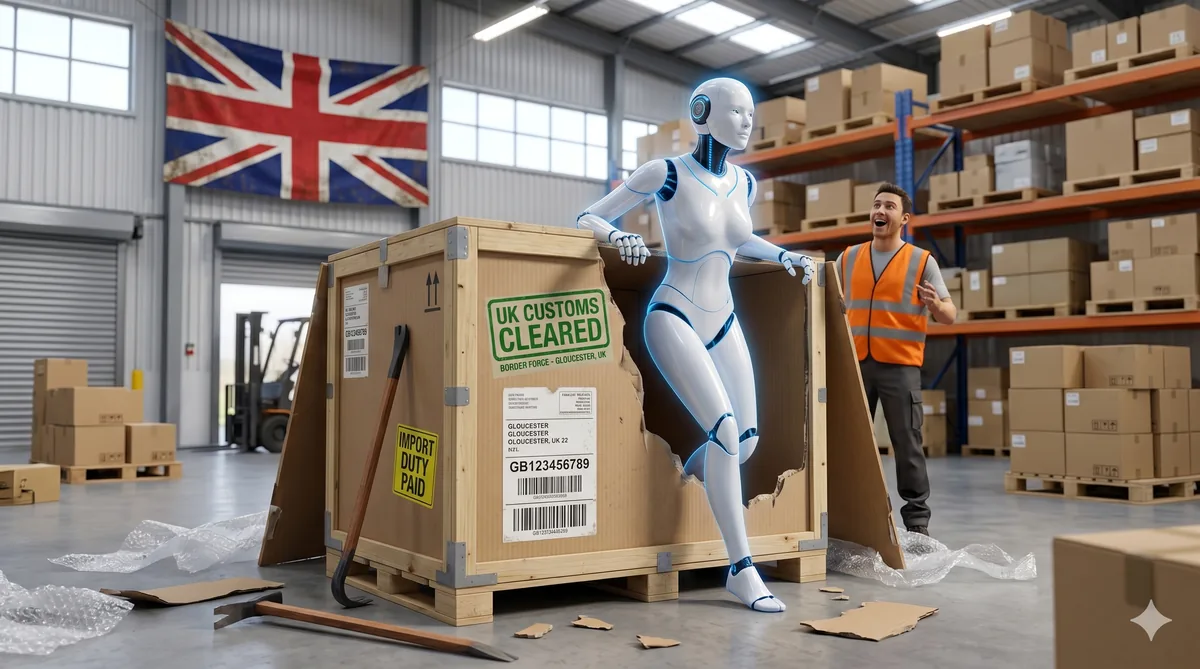
Most humanoid robots available to UK buyers are manufactured outside the country — in the US, China, Norway, or Germany. That means importing is not optional; it’s part of the buying process. Whether you’re ordering a Unitree R1 from a Chinese distributor or pre-ordering a 1X NEO from Norway, understanding the import process will save you money, avoid delays, and prevent your robot from sitting in a customs warehouse while you scramble for paperwork.
We’ve put together this step-by-step guide covering everything a UK buyer needs to know about importing a humanoid robot, from customs codes and duty rates to lithium battery regulations and common pitfalls. If you want a broader breakdown of total UK costs, see our detailed price guide.
Pre-Purchase Checklist
Before you place an order, work through this checklist. Getting these details right upfront prevents expensive problems later.
CE/UKCA marking. Check that the robot carries CE marking. The UK government confirmed that CE marked products will continue to be accepted on the UK market indefinitely, so a CE mark from the EU is valid. UKCA marking is also accepted but rarely seen on robots manufactured outside the UK. If a robot carries neither mark, it may be refused at customs or lack the safety certification required for consumer electronics in the UK.
Voltage and plug compatibility. Most humanoid robots ship with US (110V) or EU (220V) chargers. UK mains runs at 230V/50Hz, which is compatible with EU chargers. You’ll likely need a plug adapter (Type G), or better yet, a replacement UK cable if the charger uses a standard IEC connector. Avoid cheap travel adapters for expensive equipment — invest in a proper one.
Warranty coverage. International warranties vary enormously. Some manufacturers honour global warranties; others limit coverage to the country of purchase. Check before you buy, and read our warranty and support guide for manufacturer-specific details.
Spare parts and servicing. If something breaks, can you get parts shipped to the UK? Is there a UK-based repair service? For robots costing £10,000+, this is not a trivial consideration.
Retailer legitimacy. The humanoid robot market has attracted scam sellers. Buy only from verified retailers and authorised distributors. Our guide on where to buy humanoid robots in the UK lists trusted sources.
Step-by-Step Import Process
Here’s what actually happens when you order a humanoid robot from an overseas manufacturer or retailer.
Step 1: Place Your Order
Order from the manufacturer or an authorised distributor. Confirm the shipping destination is the UK and ask whether the seller handles export documentation. Reputable sellers will provide a commercial invoice listing the product description, value, country of origin, and HS commodity code.
Step 2: Shipping and Transit
The seller ships the robot via international courier (DHL, FedEx, UPS) or freight forwarder. Transit times vary: courier shipments from China typically take 5-10 working days; from the US or Europe, 3-7 working days. The courier will usually act as your customs broker automatically — more on this below.
Step 3: Customs Declaration
When the shipment arrives in the UK, it must clear HMRC customs. The courier or freight agent submits a customs declaration on your behalf, using the commercial invoice. You’ll need to provide your EORI number (Economic Operators Registration and Identification) if you’re importing as a business, though private individuals importing for personal use typically don’t need one for a one-off purchase — the courier handles it.
Step 4: Pay Duty and VAT
HMRC assesses customs duty and import VAT based on the declared value and commodity code. The courier pays these on your behalf and invoices you separately (sometimes before delivery, sometimes after). Expect to pay the courier’s disbursement fee on top — typically £10-25.
Step 5: Delivery
Once customs clears, the courier delivers to your door. The whole process — from order to delivery — usually takes 1-4 weeks depending on origin country and shipping method.
Customs Commodity Codes
Getting the right commodity code matters because it determines your duty rate. Humanoid robots can fall under several headings in the UK Global Tariff:
- 8428: Lifting, handling, loading, or unloading machinery — sometimes used for industrial robots
- 8479.50: Industrial robots, not elsewhere specified — the most commonly used code for general-purpose robots
- 8543.70: Electrical machines and apparatus with individual functions, not specified elsewhere — occasionally used for consumer robots with primarily electronic functions
- 9503.00: Toys — some smaller, education-focused robots may be classified here
The exact classification depends on the robot’s primary function. A Unitree R1 would likely fall under 8479.50, whilst a NOETIX Bumi might be argued as 9503.00 given its educational focus. If you’re unsure, HMRC’s Trade Tariff tool lets you search by product description, or you can request a Binding Tariff Information ruling for certainty.
Duty Rates and Tariff Suspensions
Here’s the good news: many robotics categories currently attract 0% customs duty under the UK’s autonomous tariff suspension programme. This programme temporarily reduces or eliminates duties on goods that aren’t manufactured domestically, and robotic equipment has benefited from several suspensions.
However, the standard MFN (Most Favoured Nation) duty rates, where applicable, range from 0% to around 3.7% for most robotic and electronic equipment. Some categories attract higher rates — up to 4.5% — depending on classification.
Key point: Even if duty is 0%, you still need to declare the goods and clear customs. Zero duty does not mean zero paperwork.
VAT Calculation
Import VAT at 20% is the biggest additional cost for UK buyers and there are no exemptions for robots. VAT is calculated on the customs value, which includes:
- The price paid for the robot
- Shipping and insurance costs to the UK
- Any customs duty payable
Example: Importing a Unitree R1 at $4,900
| Component | Amount |
|---|---|
| Product price (converted) | £3,290 |
| Shipping | £150 |
| Customs duty (0%) | £0 |
| VAT-able amount | £3,440 |
| VAT at 20% | £688 |
| Total UK cost | £4,128 |
For a full cost breakdown of every model, see our VAT and taxes guide.
Shipping Options
Courier (DHL, FedEx, UPS)
The most common method for consumer robot purchases. Couriers handle customs clearance, door-to-door delivery, and tracking. Costs vary by weight and dimensions:
- Under 15kg (e.g., NOETIX Bumi): £80-200
- 15-35kg (e.g., Unitree R1, 1X NEO): £150-350
- 35kg+ (e.g., Unitree H2): £300-500+
Freight Forwarding
For heavier or bulkier shipments, freight forwarding by sea or air offers lower per-kilogram rates but longer transit times (sea freight from China can take 4-8 weeks). This route is more common for business buyers importing multiple units.
Insurance
We strongly recommend insuring any shipment valued over £5,000. Courier insurance is often limited to £50-100 per shipment unless you purchase additional cover. Dedicated transit insurance typically costs 1-2% of the declared value — a worthwhile investment when the cargo is a £16,000 robot.
What Happens at Customs
When your shipment arrives at a UK port or airport, HMRC’s Border Force processes it. In most cases, the process is automated and handled by your courier’s customs brokerage team. Here’s what can cause delays:
- Incomplete documentation: Missing or inconsistent commercial invoices are the most common cause of hold-ups. Ensure the seller provides a detailed, accurate invoice.
- Commodity code disputes: If HMRC disagrees with the declared commodity code, they may reclassify the goods and apply a different duty rate. This can take days to resolve.
- Physical inspection: A small percentage of shipments are selected for physical inspection. This adds 1-3 working days but is rare for consumer electronics from reputable sellers.
- Unpaid charges: If the courier can’t reach you to collect duty and VAT, the shipment sits in a bonded warehouse. Storage fees accumulate daily — typically £5-15 per day after a grace period.
Most consumer robot shipments clear customs within 24-48 hours of arriving in the UK.
CE Marking vs UKCA Marking
This is simpler than many buyers expect. The UK government announced that CE marking will continue to be recognised in Great Britain indefinitely. This means:
- A robot with CE marking can be legally sold and used in the UK
- UKCA marking is also accepted but not required for imported goods
- Northern Ireland follows EU rules under the Windsor Framework and accepts CE marking
In practice, virtually all humanoid robots available to UK consumers carry CE marking from their EU certification. You don’t need to worry about UKCA — CE is sufficient.
The safety standards behind CE marking (covering electromagnetic compatibility, electrical safety, radio equipment, and machinery safety) are broadly equivalent to what UKCA would require, so a CE-marked robot meets the essential safety requirements for UK use.
Lithium Battery Regulations
Every humanoid robot contains lithium-ion batteries, and these are subject to specific shipping regulations under IATA Dangerous Goods rules. This is the manufacturer’s and courier’s responsibility, not yours, but understanding the rules helps you avoid surprises:
- UN 3481: Lithium-ion batteries packed with equipment (the standard classification for robots shipped with batteries installed)
- Batteries must be under 100Wh per cell for standard air shipment. Most robot batteries comply, but larger industrial units may require special freight arrangements
- The shipment must include proper dangerous goods labelling and documentation
- Some couriers restrict lithium battery shipments on certain routes
If a seller tells you they can’t ship a particular robot to the UK by air, lithium battery restrictions are usually the reason. In such cases, sea freight is the alternative, though it adds weeks to delivery.
Common Mistakes to Avoid
Undervaluing the shipment. Some buyers ask sellers to declare a lower value on the commercial invoice to reduce VAT. This is customs fraud and carries serious penalties, including seizure of the goods and fines. HMRC actively checks declared values against market prices for electronics.
Ignoring the courier’s invoice. When DHL or FedEx sends you a duty and VAT bill, pay it promptly. Ignoring it leads to storage charges and eventual return of the goods to the sender — at your expense.
Buying from unverified sellers. Grey market robots may lack CE marking, carry no valid warranty, and come with incorrect documentation that complicates customs clearance. Stick to authorised retailers.
Forgetting the plug adapter. A minor point, but we’ve heard from buyers who unboxed their robot only to realise they couldn’t charge it. Order a UK adapter or replacement cable before the robot arrives.
Not budgeting for the full cost. The sticker price is never the final price for UK buyers. Always calculate duty, VAT, shipping, and insurance before committing. Our price guide has the full maths for every model.
Assuming the manufacturer handles everything. Some do, some don’t. Always clarify who is responsible for export documentation, shipping, customs brokerage, and import charges before you order.
Using a Customs Broker vs Self-Declaring
For most private buyers, you won’t need to make this choice — your courier (DHL, FedEx, UPS) includes basic customs brokerage as part of their service. They submit the declaration, pay the charges on your behalf, and invoice you.
However, if you’re importing via freight or using a less well-known shipping method, you may need to decide:
Customs broker (recommended for high-value imports):
- Professional agents who handle all HMRC paperwork
- Can advise on correct commodity codes and duty rates
- Typically charge £50-150 per shipment
- Reduce the risk of delays and classification errors
- Worth the cost for any shipment over £5,000
Self-declaring:
- You submit the customs declaration yourself via HMRC’s Customs Declaration Service
- Requires an EORI number
- No brokerage fee, but mistakes can be costly
- Only advisable if you have experience with customs procedures
For a first-time robot buyer spending several thousand pounds, we recommend letting the courier handle brokerage or hiring a professional broker. The fee is negligible compared to the cost of the robot, and the peace of mind is worth it.
Summary: Your Import Checklist
Before ordering, run through this final checklist:
- Confirmed CE marking on the robot
- Checked voltage and plug compatibility
- Verified warranty coverage for UK buyers
- Calculated total UK cost (price + shipping + duty + VAT)
- Chosen a reputable, verified seller
- Confirmed shipping method and transit time
- Arranged insurance for high-value shipments
- Budgeted for courier brokerage and disbursement fees
Importing a humanoid robot to the UK is straightforward once you understand the process. The paperwork is manageable, the duty rates are favourable, and most couriers handle the heavy lifting at customs. The main thing is to budget accurately — that 20% VAT on top of shipping and the purchase price adds up quickly.
Ready to choose your robot? Start with our guide to the best humanoid robots for UK homes, or if budget is the priority, check out our price comparison for 2026.