
Affordable Humanoid Robots Coming Soon: Future UK Availability
Upcoming budget-friendly humanoid robots expected to hit the UK market in 2026-2027. Early specs, estimated prices, and release dates.
Robots4Home Team
robots4home.uk
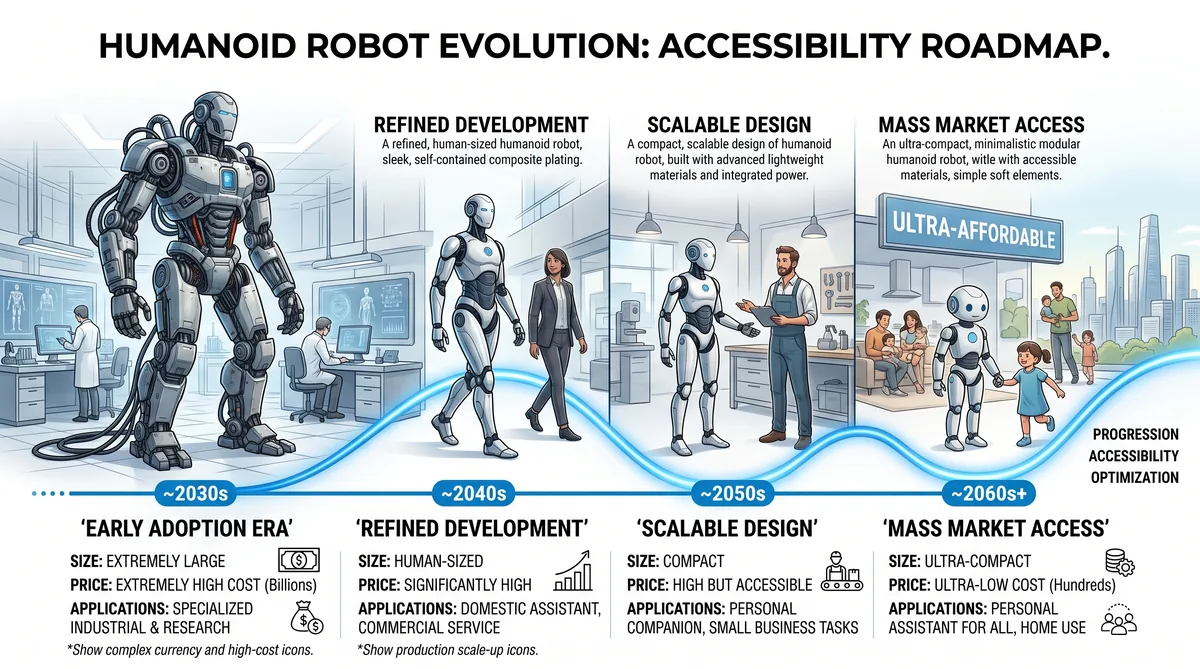
If you’ve been watching humanoid robot prices over the past two years, you’ll have noticed something remarkable: they’re falling fast. What was a quarter-million-pound research platform in 2023 is now a £50,000 commercial product, and what was completely out of reach for ordinary households is starting to creep into the realm of possibility. We’re tracking every announcement, every price drop, and every new entrant — and the picture for UK buyers is genuinely exciting.
Here’s our honest assessment of where affordable humanoid robots stand right now, what’s coming in the next few years, and whether you should wait or buy today.
The affordability trajectory: how we got here
The pattern is unmistakable. Each generation of humanoid robot arrives at roughly half the price of the one before it. Boston Dynamics’ Atlas cost millions in development. Tesla announced Optimus with a theoretical price target below $20,000. Chinese manufacturers then entered the race and started undercutting everyone.
This isn’t wishful thinking — it mirrors exactly what happened with drones, electric vehicles, and flat-screen televisions. The first consumer drones cost thousands; now you can pick up a capable one for under £300. Humanoid robots are on the same curve, just a few years behind.
The key drivers are straightforward: cheaper actuators, mass-produced AI chips, standardised battery technology from the EV industry, and — crucially — Chinese manufacturing scale. When Unitree released the G1 in 2024 at roughly $16,000, it sent shockwaves through the industry. That was a fraction of what competitors were charging for comparable hardware.
For a detailed breakdown of where prices sit right now, see our humanoid robot price guide for 2026.
What’s coming in 2026–2027: the budget models to watch
Several manufacturers have announced or hinted at budget-friendly humanoid robots targeting release within the next 12 to 18 months. Here are the ones we’re watching most closely.
Tesla Optimus
Tesla has been remarkably consistent about one thing: they want Optimus to eventually cost between $20,000 and $30,000 (roughly £16,000–£24,000). Elon Musk has suggested the long-term target could be even lower. The current generation is being deployed internally at Tesla factories, and limited external sales are expected to begin soon. Whether the consumer price point arrives in 2027 or slips to 2028 remains uncertain, but Tesla’s manufacturing expertise and vertical integration give them a genuine shot at hitting aggressive price targets.
Unitree: the price-slashing track record
If any company is going to deliver a shockingly cheap humanoid robot, it’s Unitree. Their track record speaks for itself — they’ve consistently released products at price points that make competitors wince. The Unitree H1 and G1 established them as the value leaders in the humanoid space, and we fully expect their next consumer-oriented model to push prices even lower.
Unitree’s approach is simple: build capable hardware, keep margins thin, and rely on volume. For UK buyers, the main consideration is import duty and VAT on top of the base price, but even with those additions, Unitree products tend to undercut Western alternatives significantly.
Amazon and Fauna Robotics “Sprout”
The Fauna Robotics Sprout is already available at around $50,000 (approximately £40,000), positioning it as a commercial and early-adopter product. But what makes it interesting for this discussion is the strong indication that a consumer version is in development. With Amazon’s backing, distribution infrastructure, and commitment to the smart home ecosystem, a more affordable Sprout variant could arrive with serious retail support behind it.
We wouldn’t expect the consumer version before late 2027 at the earliest, but when it arrives, Amazon’s logistics network means UK availability could follow quickly.
Other contenders
Keep an eye on Figure, Apptronik, and several Chinese manufacturers including UBTECH and Fourier Intelligence. Each has signalled interest in bringing prices down, and the competitive pressure is intensifying quarter by quarter.
Subscription models: the affordability hack
Here’s where things get genuinely interesting for UK households on a budget. Rather than paying tens of thousands upfront, several manufacturers are exploring subscription and lease models that spread the cost dramatically.
The standout example is 1X Technologies and their NEO robot. At approximately £335 per month on a subscription plan, you’re looking at the cost of a modest car lease — not cheap by any means, but vastly more accessible than a £20,000+ lump sum. The subscription typically includes maintenance, software updates, and hardware upgrades, which removes the risk of your investment becoming obsolete.
This model makes particular sense for humanoid robots because the software is evolving so rapidly. A robot you buy today will be significantly more capable in twelve months purely through over-the-air updates. Subscription models align the manufacturer’s incentive (keep improving the product) with your interest (get a robot that keeps getting better).
We expect more manufacturers to adopt this approach throughout 2026 and 2027. If your budget can stretch to £300–£400 per month but a five-figure purchase is out of the question, subscriptions may be your best route into humanoid robot ownership.
What “affordable” actually means right now
Let’s be honest about terminology. When we say “affordable humanoid robots,” we’re not yet talking about impulse purchases. The current budget tier for a genuine humanoid robot in the UK sits between roughly £1,100 and £4,000. That’s the range where you can get a real, functional humanoid-form robot delivered to your door.
At the lower end — around £1,100 — you’ll find robots like the Bumi, which is currently the cheapest humanoid robot you can buy in the UK. It’s compact, capable of basic tasks, and represents genuine value for money. At the upper end of the budget tier, around £3,900, the Unitree G1 offers more advanced capabilities and a taller form factor.
For a comprehensive look at options in this range, check out our guide to humanoid robots under £5,000 in the UK.
These prices are roughly comparable to a decent laptop, a mid-range e-bike, or a couple of months’ rent in many parts of the UK. They’re not trivial sums, but they’re within reach for many households — especially those who’ve been saving with this purchase in mind.
Sub-£1,000 humanoid robots: when will they arrive?
This is the question everyone asks, and we think the honest answer is 2028 to 2029 for a genuinely useful humanoid robot under £1,000.
Here’s our reasoning. The core components — actuators, processors, batteries, and sensors — all need another couple of generations of cost reduction. Chinese manufacturers are driving this aggressively, but even with their scale advantages, the bill of materials for a human-sized bipedal robot with capable manipulation is difficult to squeeze below a certain floor.
What we might see sooner — possibly late 2027 — are smaller humanoid robots with limited functionality at the sub-£1,000 mark. Think desktop-sized companions or educational platforms rather than robots that can fetch you a cup of tea. Full-sized, genuinely helpful humanoid robots under £1,000 are a 2028–2029 proposition at the earliest.
That said, if the subscription model takes off, you could effectively be “using” a much more expensive robot for well under £1,000 per quarter by 2027. The economics of access versus ownership may make the sticker price less relevant than it seems today.
For our broader predictions on where this technology is heading, read our future home robotics predictions.
What to buy NOW if you’re on a budget
If you’ve got the budget and the interest, here’s what we’d recommend today.
Under £1,500: Bumi (approximately £1,100)
The most affordable humanoid robot currently available in the UK. It won’t do your laundry, but it’s a genuine humanoid-form robot with real capabilities, and it gives you hands-on experience with the technology. It’s an excellent entry point.
Under £4,000: Unitree G1 (approximately £3,900)
Significantly more capable than the budget options, with better mobility and manipulation. If you can stretch to this price point, the G1 represents outstanding value and gives you a robot that can genuinely participate in daily life in meaningful ways.
Under £10,000: multiple options emerging
This bracket is filling up fast. Several models are expected to launch in this range during 2026, giving UK buyers genuine choice for the first time.
For our full recommendations, see the best humanoid robots for home use in the UK.
Should you wait or buy now?
We get asked this constantly, and our answer is consistent: don’t wait.
Here’s why. Yes, prices will come down. Yes, next year’s models will be more capable. That will also be true the year after that, and the year after that. If you wait for the “perfect” time to buy, you’ll be waiting forever — just as you would if you refused to buy a phone until they stopped improving.
The robots available today are functional, useful, and — critically — they’re teaching early adopters how to live with humanoid robots in their homes. That experience is genuinely valuable. The people who buy now will understand exactly what they want from their next robot. They’ll make better purchasing decisions in 2028 because they bought in 2026.
Moreover, many of today’s robots receive regular software updates that materially improve their capabilities. The robot you buy today will be better in six months without you spending another penny. That’s a fundamentally different proposition from buying a television or a washing machine.
Our advice: buy what you can afford now, learn from it, enjoy it, and upgrade when something compelling arrives at a price point that makes sense for you. The technology is already good enough to be useful and entertaining — waiting for perfection means missing out on years of genuine value.
UK-specific pricing considerations
A few things UK buyers should keep in mind.
VAT and import duty add significantly to the sticker price of robots manufactured outside the UK (which is currently all of them). A robot advertised at $2,000 in the US won’t cost you £1,600 — once you add 20% VAT and potential import duties, you’re looking at closer to £2,000–£2,200. Always factor this in when reading US-centric price announcements.
Shipping costs for heavy robotics hardware can be substantial. Some manufacturers include UK shipping in their prices; others don’t. Check before you commit.
Warranty and support vary enormously. Buying from a manufacturer with UK-based support or an authorised UK distributor can save you considerable headache if something goes wrong. This is worth paying a modest premium for.
Power compatibility is generally not an issue — most modern robots use universal power supplies — but it’s always worth confirming that the charging system works with UK mains without requiring adapters.
The bottom line
Affordable humanoid robots aren’t a distant dream — they’re arriving now, with prices falling each quarter and new budget models on the horizon. The current sweet spot for UK buyers is the £1,100–£4,000 range, with subscription models offering an alternative path for those who’d rather spread the cost. Sub-£1,000 robots are realistic by 2028–2029, and subscription access could get you there even sooner.
The market is moving fast. We’ll keep updating our guides as new models launch and prices shift. If you want to stay informed, bookmark our price guide — we update it regularly as the landscape evolves.