
Humanoid Robots Under £5,000 in the UK: Budget Buyer's Guide
Find the best affordable humanoid robots for UK buyers. We compare every model under £5,000 including the Unitree R1 and NOETIX Bumi.
Robots4Home Team
robots4home.uk
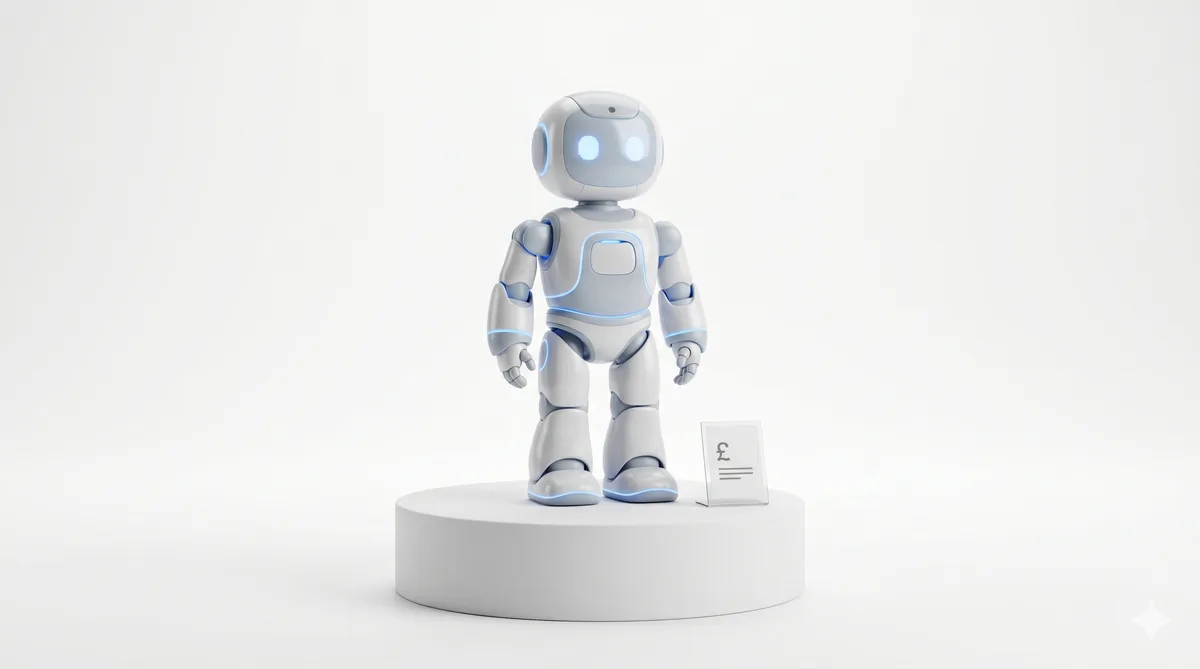
If you want a humanoid robot in the UK without spending five figures, your options are remarkably clear. As of early 2026, exactly two humanoid robots fall under the £5,000 mark: the NOETIX Bumi at roughly £1,100 and the Unitree R1 at approximately £3,900. That’s it. Everything else — the Unitree G1, the 1X NEO, the Figure 03 — sits comfortably above that threshold.
We’ve tested both machines extensively. This guide breaks down what each robot offers, compares them head-to-head, and helps you decide which one (if either) is right for your situation. If you’re looking for the broader picture, our humanoid robot price guide covers every model available to UK buyers at every price point.
The Two Robots Under £5,000
NOETIX Bumi — £1,100
The Bumi is the cheapest walking humanoid robot you can buy anywhere in the world. Standing 94cm tall and weighing 12kg, it’s compact, lightweight, and genuinely charming. It walks with a stable gait on hard floors and low-pile carpet, recognises up to 20 faces, responds to voice commands, and performs a surprisingly entertaining library of dance routines.
It’s built as a companion and education platform. NOETIX provides a visual programming environment for younger users and a full Python SDK for hobbyists and developers. Battery life is around two hours per charge, with a 90-minute recharge via the included dock.
What the Bumi won’t do is perform household tasks. At its size and with its simple grippers, it cannot fetch objects, open doors, or handle anything requiring fine manipulation. It doesn’t map your home or navigate complex routes autonomously. Think of it as a walking, talking introduction to humanoid robotics — not a domestic assistant.
We cover the Bumi in detail in our full review.
Unitree R1 — £3,900
The R1 is a fundamentally different machine. At 123cm tall and 29kg, it’s larger, heavier, and dramatically more capable. Built by Unitree Robotics — the company that made its name with agile quadruped robots — the R1 uses proprietary quasi-direct-drive actuators that give it exceptional responsiveness and balance.
The locomotion is outstanding. The R1 runs at up to 3.3 metres per second, executes cartwheels and backflips, and recovers from pushes that would topple most competitors. It navigates autonomously using LiDAR and depth cameras, adapts its gait to different surfaces in real time, and handles transitions between floor types without breaking stride.
Like the Bumi, the R1’s manipulation capabilities are limited at this stage. It handles basic object interaction but won’t be loading your dishwasher. Battery life is similar at roughly two hours. But the sheer quality of its movement — the speed, the agility, the confidence — is in a different league entirely.
Our Unitree R1 review has the full breakdown.
Head-to-Head Comparison: What You Get at Each Price
| Feature | NOETIX Bumi (£1,100) | Unitree R1 (£3,900) |
|---|---|---|
| Height | 94cm | 123cm |
| Weight | 12kg | 29kg |
| Walking | Stable, slow gait | Adaptive, dynamic gait |
| Running | No | Yes (up to 3.3 m/s) |
| Acrobatics | Dance routines | Cartwheels, backflips |
| Fall recovery | Limited — stays upright from gentle nudges | Recovers from strong pushes mid-stride |
| Navigation | Basic waypoint commands | Autonomous LiDAR + depth camera mapping |
| Face recognition | Yes (up to 20 faces) | Yes |
| Voice commands | Yes | Yes |
| Object manipulation | Simple grippers | Basic interaction |
| Battery life | ~2 hours | ~2 hours |
| Programming | Visual blocks + Python SDK | SDK + developer platform |
| Build quality | ABS plastic, solid for price | Polycarbonate + rubberised impact zones |
| CE marked | Yes | Yes |
All UK prices include estimated 20% VAT and shipping. Exchange rates fluctuate — check our price guide for current figures.
Is the Unitree R1 Worth 3.5x the Price of the Bumi?
This is the central question, and the honest answer depends entirely on what you want a humanoid robot to do.
If you want to own a walking humanoid robot and explore the technology, the Bumi delivers on that promise at a fraction of the cost. It walks, it talks, it recognises your family, and the educational programming tools are genuinely excellent. For families with children interested in robotics, for classrooms, or for anyone who simply wants to see a bipedal robot stroll across their living room, £1,100 is a reasonable entry point. You’re not paying for cutting-edge performance — you’re paying for access to the category.
If you care about what the robot can actually do, the R1 is worth every penny of the premium. The gap between these two machines is not incremental. The Bumi walks; the R1 runs, flips, and recovers from being shoved. The Bumi follows basic waypoints; the R1 maps your home autonomously and navigates around furniture. The R1’s build quality, actuator technology, and control software are closer to what you’d find in machines costing ten times as much.
We think most buyers who can afford the R1 will be happier with it in the long run. The Bumi is a charming novelty that delivers real educational value, but the R1 feels like a genuinely capable platform with room to grow as software updates expand its functionality. If you’re spending money on a humanoid robot because you’re excited about where this technology is heading, the R1 puts you much closer to the frontier.
That said, £3,900 is still a significant outlay. If you’re unsure whether humanoid robotics is for you and you’d rather test the waters without a large financial commitment, the Bumi is the safer bet. You’ll learn a great deal about what living with a humanoid robot is actually like, and you’ll spend less doing it.
What Sits Just Above the £5,000 Mark
The next step up from the R1 is the Unitree G1 at approximately £10,800. It builds on the R1’s mobility platform with improved manipulation capabilities, more advanced sensor arrays, and better AI-driven task execution. If your budget can stretch to five figures, the G1 offers a meaningful upgrade — particularly in object handling and environmental awareness.
Beyond that, you’re looking at the 1X NEO (around £16,000, or available on a subscription model at £335 per month) and the Figure 03 (closer to £30,000). These are substantially more capable machines, but they’re also in a completely different price bracket. For a full rundown, see our guide to the best humanoid robots for UK homes.
UK Import Costs and How to Buy
Neither the Bumi nor the R1 is manufactured in the UK, so import costs are part of the equation. The prices we’ve quoted throughout this guide include estimated UK costs — base price, international shipping, and 20% import VAT.
For the NOETIX Bumi, you’ll order directly from NOETIX in USD. The robot ships internationally via courier, and UK customs will collect import VAT either on delivery or shortly after. The process is straightforward, and delivery typically takes two to four weeks.
For the Unitree R1, there are a few more options. Some UK-based resellers stock Unitree products, which simplifies the process — you pay in GBP, VAT is included, and delivery is faster. Alternatively, you can order through Unitree’s authorised international distributors or via Amazon UK. Delivery typically takes one to three weeks.
In both cases, expect a small brokerage fee from the courier handling customs clearance — usually between £10 and £30. We’ve written a detailed breakdown of VAT and taxes on humanoid robots in the UK if you want the full picture.
One thing to budget for: exchange rate fluctuations. Both robots are priced in foreign currencies, so the GBP cost can shift by £50 to £150 depending on when you buy. The prices in this guide are estimates based on early 2026 exchange rates.
Our Recommendations by Buyer Type
Families and educators: The NOETIX Bumi at £1,100. The educational tools are excellent, the robot is safe and appropriately sized for children, and the price makes it accessible for schools and households that want to introduce robotics without a major financial commitment.
Hobbyists and early adopters: The Unitree R1 at £3,900. If you’re buying a humanoid robot because you’re genuinely passionate about the technology, the R1 delivers an experience that the Bumi simply cannot match. The agility, the build quality, and the development platform are all significantly superior.
Developers and researchers: The R1, without hesitation. Its actuator technology, control software, and SDK make it a far more capable development platform. If you’re building applications or conducting research, the Bumi’s limitations will frustrate you quickly.
Curious newcomers on a tight budget: The Bumi. Spending £1,100 to discover whether you’re genuinely interested in humanoid robotics is a much easier decision than spending £3,900. If the Bumi sparks a deeper interest, you can always upgrade later.
Anyone who wants maximum capability under £5,000: The R1. It’s not close.
Final Thoughts
The humanoid robot market under £5,000 is small — just two machines — but both are honest products at fair prices. The NOETIX Bumi offers an affordable entry point into a category that barely existed for consumers two years ago. The Unitree R1 delivers performance that would have been unimaginable at this price point even recently.
Neither robot will replace a household assistant or carer. That’s still several years and several thousand pounds away. But if you want a humanoid robot in your home today and you’d rather not spend five figures, these are your options — and they’re better options than most people expect.
For more help deciding, see our complete guide to the cheapest humanoid robots in the UK or browse our full buyer’s guide.