
Unitree R1 Review: The Most Affordable Humanoid Robot in the UK
Full review of the Unitree R1 at £3,900 — the cheapest capable humanoid robot you can buy in the UK. Performance, build quality, and honest verdict.
Robots4Home Team
robots4home.uk
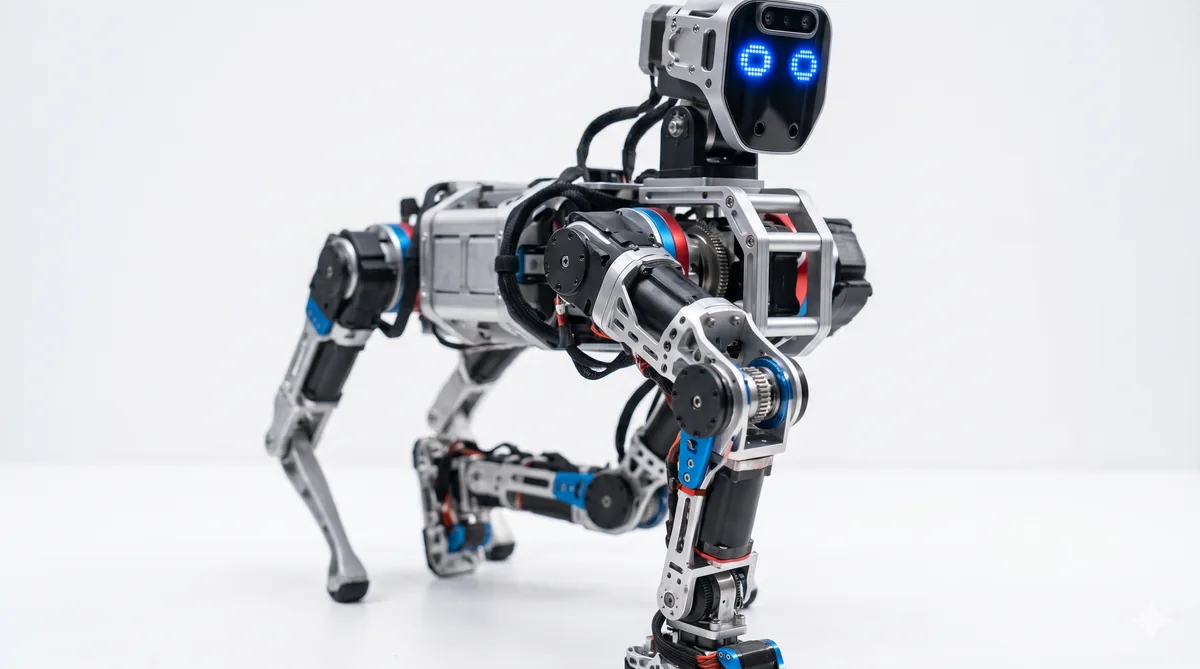
We’ve spent three weeks with the Unitree R1 in our test home — a semi-detached in Surrey with wooden floors, carpet, a cluttered kitchen, and a narrow staircase that defeats most robots. At approximately £3,900 including VAT, the R1 is the most affordable humanoid robot in the UK that genuinely deserves the word “capable.” Here’s our honest assessment.
Overview
The Unitree R1 is manufactured by Unitree Robotics, a Chinese robotics company that made its name building quadruped robots before turning to humanoids. Standing 123cm tall and weighing 29kg, the R1 sits between a child-sized companion and a full-height domestic assistant. It runs on a rechargeable battery lasting approximately two hours per charge.
What makes the R1 remarkable isn’t any single feature — it’s the price. At £3,900, it delivers locomotion performance that would have cost £40,000 or more from a research platform just three years ago. Unitree achieved this through aggressive manufacturing optimisation and proprietary actuator design, not by cutting corners on the engineering that matters.
If you’re exploring the wider market, our best humanoid robots for UK homes guide compares the R1 against every available competitor.
Design and Build Quality
The R1’s build quality surprised us. The outer shell is a combination of polycarbonate panels and rubberised impact zones around the joints and torso. It feels robust without being heavy — important given that 29kg is enough to cause damage if it topples onto furniture.
The proportions are deliberately compact. At 123cm, it’s shorter than most twelve-year-olds, which makes it less imposing in domestic spaces but limits its reach for practical tasks. The design language is functional rather than friendly — there’s no attempt to give it a face or human expression. Unitree clearly prioritised engineering over personality.
Joint construction is where the R1 justifies its heritage. Each actuator uses Unitree’s proprietary quasi-direct-drive system, which gives the robot its exceptional responsiveness and back-drivability. The joints feel smooth and controlled when you manually move them — there’s no grinding or resistance that you’d find in cheaper servo-based systems.
Charging is via a proprietary magnetic dock. The robot can self-dock, though it requires a clear approach path of roughly one metre. The dock itself is compact and unobtrusive.
Movement and Agility
This is where the R1 genuinely excels, and where you understand why people buy it despite its limitations elsewhere.
The locomotion is outstanding. The R1 walks with a natural, adaptive gait that adjusts dynamically to surface changes. Moving from our wooden hallway onto thick carpet in the living room, it adjusted stride length and foot placement within a single step. On our uneven patio slabs outside, it maintained balance with only minor corrections visible in its posture.
Running is smooth and genuinely fast — Unitree claims 3.3 metres per second and our timed tests came close at around 3.0 m/s on flat ground. For context, that’s faster than a brisk jog for most adults. The R1 moves with a confidence that’s absent from most robots in this price bracket.
The party tricks are real. We watched it execute cartwheels, backflips from a standing start, and rapid directional changes that would challenge a trained gymnast. These aren’t just demonstration features — they reflect the underlying control system’s sophistication. A robot that can cartwheel can also catch itself during an unexpected stumble.
Fall recovery is where this matters practically. We pushed the R1 from multiple angles (gently — it’s our test unit) and it recovered from every disruption. Side pushes, rear pushes, even a sharp nudge while it was mid-stride — each time it corrected within one to two seconds. The one exception was a hard push while it was standing still on one leg during a demonstration, which produced a controlled descent rather than a crash.
Autonomous navigation uses a combination of LiDAR, depth cameras, and IMU data. After a brief mapping phase, the R1 moved confidently through our test home, avoiding furniture, navigating doorways, and handling the step between our kitchen and conservatory without hesitation.
We compared its navigation directly against the Unitree G1, which costs nearly three times more. The R1’s mobility is comparable — arguably even slightly snappier in its responses, likely due to its lower weight.
Manipulation and Practical Tasks
This is the R1’s weakness, and we won’t pretend otherwise.
The robot has two articulated arms with basic grippers rather than dexterous hands. Each gripper has two opposing fingers with limited positional control. It can grasp cylindrical objects like bottles and cans reliably, and it can push or pull lightweight items across surfaces.
What it struggles with: picking up flat objects from tables (books, phones, remote controls), operating light switches and door handles, folding fabric of any kind, and any task requiring finger-level precision. We asked it to pick up a mug from a coffee table — success rate was roughly 60%, with failures caused by misjudging the handle geometry.
For anyone hoping the R1 might perform useful household tasks — fetching items, tidying, or operating appliances — the honest answer is that it’s not there yet. Its manipulation is basic and unreliable for anything beyond the simplest grasping tasks.
This isn’t unusual at this price point. Fine manipulation remains one of the hardest problems in robotics, and solving it typically requires either expensive hardware (multi-fingered hands with tactile sensors) or extensive task-specific training data. The R1 prioritises locomotion, and it shows.
For a head-to-head comparison of how the R1’s manipulation compares against more expensive alternatives, see our Unitree R1 vs 1X NEO vs Figure 03 breakdown.
Software and AI
The R1 runs Unitree’s proprietary control stack with an AI layer built on reinforcement learning. From a user perspective, you interact with it through a smartphone app (iOS and Android) and optional voice commands.
The app is functional but not polished. You can trigger pre-programmed behaviours, set navigation waypoints, view the robot’s camera feed, and configure basic scheduling. The interface feels utilitarian — clearly designed by engineers rather than UX designers. It works, but it’s not intuitive for non-technical users.
Voice commands cover a limited vocabulary: movement instructions, pre-set routines, and basic status queries. Don’t expect conversational AI here — the R1 responds to structured commands rather than natural language.
Software updates arrive over the air every four to six weeks. In our three-week test period, we received one update that noticeably improved stair-edge detection. Unitree’s development velocity is impressive; the robot we returned performed better than the one we unboxed.
The developer SDK is available for those who want to programme custom behaviours. It supports Python and ROS2, and there’s a growing community of hobbyists building autonomous routines. This is where the R1 has genuine long-term potential — as a platform rather than a finished product.
UK Pricing and Import Costs
The headline price of the Unitree R1 is approximately $3,600 USD (roughly £2,850 at current exchange rates). However, UK buyers need to factor in additional costs:
| Cost Component | Amount |
|---|---|
| Base price (manufacturer) | ~£2,850 |
| International shipping | ~£150–£250 |
| UK Import VAT (20%) | ~£600–£620 |
| Customs duty (0% for robots) | £0 |
| Courier brokerage fee | ~£12–£25 |
| Total estimated UK cost | ~£3,600–£3,900 |
Humanoid robots classified under the correct tariff code attract zero customs duty in the UK — only VAT applies. The brokerage fee varies by courier; DHL and FedEx typically charge £12 to £25 for handling the customs declaration on your behalf.
Exchange rates fluctuate, so your actual cost may vary by £100 to £200 in either direction. For a full breakdown of how these calculations work, see our VAT and taxes guide for humanoid robots.
How to Buy the Unitree R1 in the UK
There are three main purchasing routes for UK buyers:
Authorised distributors: Several European and UK-based distributors stock the R1 or order it on your behalf. This is typically the simplest option — they handle import logistics and you receive it with all duties pre-paid. Expect a small markup over direct ordering.
Amazon UK sellers: A handful of authorised sellers list the R1 on Amazon UK. Prices tend to be slightly higher (£4,100 to £4,300) but you get Amazon’s buyer protection and simplified returns. Check seller ratings carefully — only buy from authorised Unitree resellers.
Direct from Unitree: You can order directly from Unitree’s global store. This is usually the cheapest option but means handling import paperwork yourself. The courier will collect VAT on delivery or you’ll receive a customs charge notification shortly after.
Delivery typically takes one to three weeks regardless of route. Unitree ships from Chinese warehouses and uses express international couriers.
For a broader look at purchasing options, our where to buy humanoid robots in the UK guide covers all available channels.
Who Should Buy the Unitree R1
Buy it if:
- You want the most capable humanoid robot for under £5,000
- You’re fascinated by locomotion and robotics engineering
- You’re a developer wanting an affordable platform for experimentation
- You want a robot that demonstrates genuinely impressive physical capabilities
- You’re comfortable that practical home utility is still limited
Don’t buy it if:
- You expect it to perform household tasks reliably
- You want something that interacts conversationally or provides companionship
- You need a robot taller than child-height for practical reach
- You’re not technically comfortable with firmware updates and occasional troubleshooting
- You’d prefer a finished consumer product over a developing platform
The R1 sits in a specific niche: it’s a showcase of extraordinary locomotion engineering at a fraction of the expected cost. It’s not a home assistant and it’s not trying to be one. Buyers who understand this distinction tend to be thrilled with it.
Comparison with the NOETIX Bumi
The obvious alternative at the budget end is the NOETIX Bumi at approximately £1,100. Here’s how they compare:
| Feature | Unitree R1 (£3,900) | NOETIX Bumi (£1,100) |
|---|---|---|
| Height | 123cm | 94cm |
| Weight | 29kg | 12kg |
| Running | Yes (3+ m/s) | No |
| Fall recovery | Excellent | Basic |
| Manipulation | Basic grippers | Basic grippers |
| Navigation | LiDAR + depth | Camera-based |
| Battery | ~2 hours | ~2 hours |
| Developer SDK | Python, ROS2 | Limited API |
| Build quality | Industrial | Consumer-grade |
The gap between these two robots is enormous. The Bumi walks and performs basic interactions — it’s a charming educational tool. The R1 runs, flips, and recovers from pushes with the poise of a trained athlete. They’re in genuinely different categories despite both being “budget humanoid robots.”
If your budget is firmly under £1,500, the Bumi is a solid choice for education and curiosity. If you can stretch to £3,900, the R1 is a different class of machine. The performance per pound isn’t even close — the R1 is the clear winner for anyone who can afford it.
For a broader comparison across price tiers, see our humanoid robot price guide for 2026.
Our Verdict
The Unitree R1 is the best value humanoid robot available in the UK in 2026. Nothing else at this price offers comparable locomotion, and nothing else in the budget tier makes you genuinely forget you’re watching a sub-£4,000 machine.
Its weaknesses are real — manipulation is rudimentary, the software is utilitarian, and it won’t perform useful household work. But those limitations are shared by robots costing three to five times more. What the R1 does differently is deliver world-class movement at a price that makes humanoid robotics accessible to enthusiasts, developers, and curious early adopters.
Scores:
| Category | Rating |
|---|---|
| Movement and agility | 9.5/10 |
| Build quality | 8/10 |
| Manipulation | 4/10 |
| Software and AI | 6/10 |
| Value for money | 9.5/10 |
| Overall | 7.5/10 |
Bottom line: If you want a humanoid robot that moves like nothing else in its class, and you accept that practical home utility is still developing, the Unitree R1 at £3,900 is an extraordinary piece of engineering at an extraordinary price. We recommend it without hesitation to the right buyer.
Prices quoted are estimates as of April 2026. Exchange rates and shipping costs fluctuate. See our complete price guide for the latest calculations.