
Unitree G1 Review: Compact Humanoid Robot Performance Test
The Unitree G1 sits in the £10,800-£12,800 range. We test its capabilities for home and research use in a UK environment.
Robots4Home Team
robots4home.uk
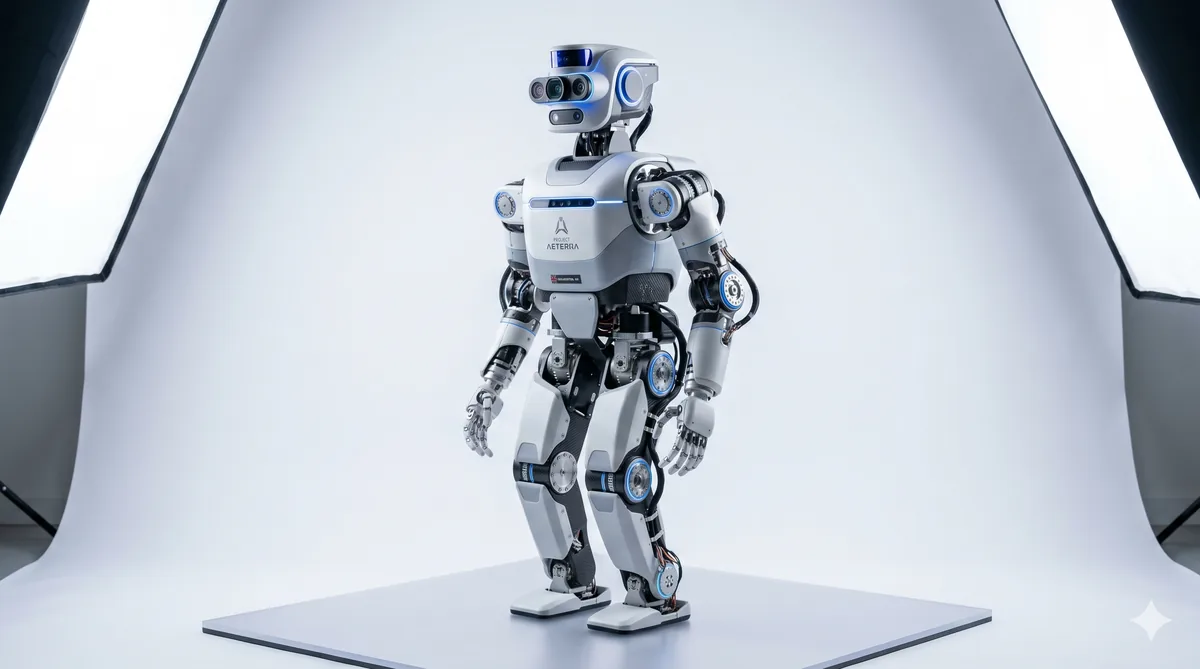
We’ve been testing the Unitree G1 for four weeks in our Surrey test home, pushing it through every domestic scenario we could devise. At £10,800 to £12,800 depending on configuration, the G1 occupies a fascinating middle ground — substantially more capable than the budget R1 but well below the premium tier occupied by machines like the Unitree H2. The question is whether that middle ground justifies nearly triple the R1’s price. Here’s what we found.
Overview
The Unitree G1 is the mid-range humanoid from Unitree Robotics, the Chinese manufacturer that built its reputation on quadruped platforms before producing some of the most capable bipedal robots on the market. Where the R1 is a locomotion showcase, the G1 is Unitree’s attempt at a more rounded machine — one that moves brilliantly and starts to be genuinely useful with its hands.
Standing 127cm tall and weighing 35kg, the G1 is only slightly larger than the R1, but the additional mass is concentrated in the torso and arms where it matters. Battery life sits at approximately two hours per charge — consistent with the R1 and broadly typical for this class. It ships globally through Unitree’s distribution network, with UK delivery taking two to four weeks depending on the configuration ordered.
For context on where this sits in the broader market, our mid-range humanoid robots guide compares every option in the £8,000 to £15,000 bracket.
Design and Specifications
The G1’s design philosophy is immediately recognisable as Unitree. The same functional, engineering-first aesthetic we noted in the R1 carries over here — no attempt at a friendly face, no soft curves for the sake of approachability. This is a tool, and it looks like one.
Build quality is a step up from the R1 in materials and finish. The outer panels are a mix of reinforced polycarbonate and aluminium alloy at the structural joints, with rubberised impact zones covering the shoulders, knees, and pelvis. At 35kg, it’s heavy enough that you want it to be robust, and it is. We dropped it from a standing position onto a tiled kitchen floor during fall-recovery testing and found no visible damage beyond minor scuffing on the knee pads.
The hands are where the real design investment shows. The G1 replaces the R1’s basic two-finger grippers with articulated hands featuring multiple degrees of freedom per hand. These aren’t the dexterous five-fingered systems you’d find on premium robots, but they’re a significant upgrade — each hand can independently curl, grip, and perform basic pinching motions. The difference in practical capability is noticeable.
| Specification | Detail |
|---|---|
| Height | 127cm |
| Weight | 35kg |
| Battery life | ~2 hours |
| Degrees of freedom | 43 |
| Top speed | ~3.0 m/s |
| Charging | Proprietary magnetic dock |
| Connectivity | Wi-Fi 6, Bluetooth 5.2 |
| Sensors | LiDAR, depth cameras, force/torque sensors, IMU |
| Configurations | Edu, Pro |
The charging dock is similar to the R1’s magnetic system but slightly larger to accommodate the G1’s weight. Self-docking works reliably provided the approach path is clear. Charging from empty takes roughly 90 minutes.
What the G1 Does Better Than the R1
Having reviewed the Unitree R1 extensively, we were keen to identify exactly where the additional spend translates into tangible improvement. The differences fall into three categories.
Object manipulation is substantially improved. The R1’s grippers gave it roughly a 60% success rate picking up a mug from a coffee table. The G1 managed the same task at around 85% in our tests. More importantly, the G1 can handle a wider variety of objects — it picked up a TV remote control from a flat surface (something the R1 consistently failed at), grasped a soft drink can without crushing it, and managed to carry a plate from the kitchen counter to the dining table without dropping it. It’s still far from human dexterity, but it crosses a threshold where you start seeing glimpses of genuine utility.
Environmental awareness is more sophisticated. The G1 adds force and torque sensors at the wrists alongside improved depth perception from upgraded stereo cameras. In practice, this means the robot adjusts its grip strength based on what it’s holding and navigates cluttered environments with greater confidence. We deliberately scattered shoes, bags, and children’s toys across our hallway — the G1 picked a path through without contact, whereas the R1 occasionally nudged items aside.
The AI layer is more capable. The G1’s onboard processing handles more complex task sequences. Where the R1 responds to individual commands, the G1 can chain actions together — “go to the kitchen, pick up the water bottle from the counter, and bring it here” worked about seven times out of ten in our testing. The R1 would require each step to be commanded separately.
Locomotion, however, is broadly equivalent. The G1 walks and runs with the same impressive Unitree gait, and its fall recovery is equally strong. The extra 6kg of weight doesn’t noticeably slow it down, though its acrobatic demonstrations (backflips, cartwheels) feel slightly less nimble than the lighter R1’s. Both machines share the same underlying control architecture for movement, and it shows.
Practical Capabilities
We tested the G1 across a range of domestic scenarios to assess its real-world usefulness. The results paint a picture of a robot that’s genuinely more capable than budget options but still requires supervision for anything beyond simple tasks.
Fetching and carrying: Reliable for lightweight, rigid objects. Bottles, cans, small boxes, and plates were handled with good consistency. Soft or irregular items — a folded towel, a bag of crisps, a stuffed toy — produced mixed results. The robot understands the task but its hands lack the tactile sensitivity to adjust grip on compliant materials reliably.
Navigation in cluttered spaces: Excellent. The G1 mapped our entire test home within minutes and navigated confidently through rooms with furniture, doorways, and the step between our kitchen and conservatory. It handled our narrow hallway (78cm wide) without brushing the walls, which impressed us given its shoulder width.
Basic tidying: Partial success. We asked the G1 to clear a coffee table with five objects on it and place them on a nearby shelf. It managed three out of five objects before misjudging the placement of a book and dropping it. The intent recognition and task planning worked — execution was the limiting factor.
Monitoring and presence: The G1 can patrol a defined route, stream video to your phone, and alert you to unexpected activity. As a mobile security camera with legs, it’s effective. Whether that justifies the price compared to a dedicated security system is debatable, but the flexibility of a robot that can check any room on demand has genuine appeal.
Household chores: Still largely aspirational. The G1 cannot load a dishwasher, fold laundry, or operate most appliances. It can press large buttons and flip oversized switches, but fine interaction with the physical environment remains a challenge. This is the honest reality of mid-range humanoid robots in 2026 — they’re approaching utility without quite reaching it.
For context on what current home robots can actually do around the house, our best humanoid robots for UK homes guide breaks down capabilities by price tier.
Software and SDK
The G1 runs Unitree’s latest control stack, which represents a meaningful upgrade from the R1’s software. The mobile app (iOS and Android) is the same platform but unlocks additional features for the G1, including multi-step task programming, a visual task builder for creating custom routines, and more granular control over movement parameters.
Voice interaction is improved but not transformative. The G1 handles natural language commands more flexibly than the R1’s structured keyword system — you can phrase requests conversationally rather than using exact trigger phrases. Understanding is contextual to a degree; if you say “bring me that” while pointing at an object, the G1 will attempt to identify the target using its cameras. Success depends heavily on the object and lighting conditions.
The developer SDK is where the G1 becomes genuinely interesting for technical buyers. It supports Python, C++, and ROS2, with comprehensive API access to sensor data, motor control, and the perception pipeline. The community around Unitree’s SDK has grown rapidly, and there are now active repositories of shared behaviours, trained models, and integration examples. For researchers and hobbyists, this ecosystem alone may justify choosing the G1 over alternatives with less developer support.
The Pro configuration includes enhanced SDK features such as real-time sensor data streaming, advanced motion planning libraries, and priority access to beta firmware. The Edu configuration ships with the standard SDK plus a structured tutorial programme designed for university-level robotics courses.
Over-the-air updates arrive regularly — we received two during our four-week test period. Both were minor but one improved object detection accuracy in low-light conditions, which we verified through repeat testing of tasks that had previously failed in our dimly lit hallway.
UK Pricing and Configurations
The G1 is available in two main configurations for UK buyers:
| Configuration | Features | Estimated UK Price |
|---|---|---|
| G1 Edu | Standard SDK, tutorial programme, basic sensor suite | ~£10,800 |
| G1 Pro | Enhanced SDK, full sensor suite, priority updates | ~£12,800 |
These prices include shipping and UK VAT at 20%. As with the R1, humanoid robots attract zero customs duty under the correct tariff classification — only VAT applies. Exchange rate fluctuations may shift the final price by a few hundred pounds in either direction.
Both configurations share identical hardware. The difference is purely software — the Pro unlocks advanced developer tools and ships with additional trained behaviours out of the box. For most home users, the Edu configuration offers everything you need. The Pro is aimed squarely at researchers and developers who will use the expanded SDK capabilities.
Delivery takes two to four weeks through Unitree’s global distribution network. UK buyers can order directly from Unitree, through authorised European distributors, or via select Amazon UK sellers (typically at a modest markup). For a full breakdown of import costs and purchasing routes, see our humanoid robot price guide for 2026.
Who Should Buy the G1
Buy it if:
- You’ve outgrown the R1’s capabilities and want improved manipulation
- You’re a developer or researcher seeking a capable mid-range platform with strong SDK support
- You want a robot that can handle basic fetch-and-carry tasks with reasonable reliability
- You’re willing to invest in a platform that will improve meaningfully with software updates
- You want Unitree’s locomotion excellence paired with more practical hands
Skip to premium if:
- You need reliable autonomous household task completion — the G1 still requires supervision
- You want natural conversational interaction and emotional presence
- You need full-height reach for practical tasks in a standard kitchen or workspace
- You’re buying primarily for elderly care or companionship rather than technical interest
- Your budget can stretch to the Unitree H2 or equivalent premium machines
The G1 sits in a space that will suit a particular buyer profile perfectly: someone who found the R1 thrilling but limiting, who isn’t ready to spend £25,000 or more on a premium humanoid, and who values a strong development platform alongside practical capability. It’s a stepping stone, but a well-built one.
For buyers still weighing options across the mid-range bracket, our mid-range humanoid robots guide offers direct comparisons with every competitor at this price point.
Our Verdict
The Unitree G1 is a confident step forward from the R1, and it earns its higher price through genuine improvements in manipulation, perception, and AI capability. It inherits the outstanding locomotion that makes Unitree’s robots a joy to watch and adds enough practical skill to make you believe that useful domestic robots are coming — even if they’re not quite here yet.
Its limitations are honest ones. Autonomous household task completion remains unreliable without supervision. The hands are better than the R1’s grippers but still struggle with soft, irregular, or small objects. And at 127cm, it can’t reach the top shelf of a standard kitchen cupboard.
But within its capabilities, the G1 performs with a polish and consistency that budget robots simply don’t match. The SDK and developer community give it genuine long-term potential, and Unitree’s rapid update cadence means the robot you have in six months will be noticeably better than the one you bought.
Scores:
| Category | Rating |
|---|---|
| Movement and agility | 9/10 |
| Build quality | 8.5/10 |
| Manipulation | 6.5/10 |
| Software and AI | 7.5/10 |
| Value for money | 7/10 |
| Overall | 7.5/10 |
Bottom line: The Unitree G1 at £10,800 to £12,800 is the best mid-range humanoid robot available in the UK. It combines Unitree’s class-leading locomotion with meaningfully improved hands and smarter AI, wrapped in a platform that developers will love. It’s not a home assistant yet — but it’s the most convincing argument that one is on the way.
Prices quoted are estimates as of March 2026. Exchange rates and shipping costs fluctuate. See our complete price guide for the latest calculations.