
Unitree H2 Review: Heavy-Duty Humanoid for Serious Applications
At £23,900, the Unitree H2 is a serious machine. Our review covers whether it's worth the price for professional and advanced home use.
Robots4Home Team
robots4home.uk
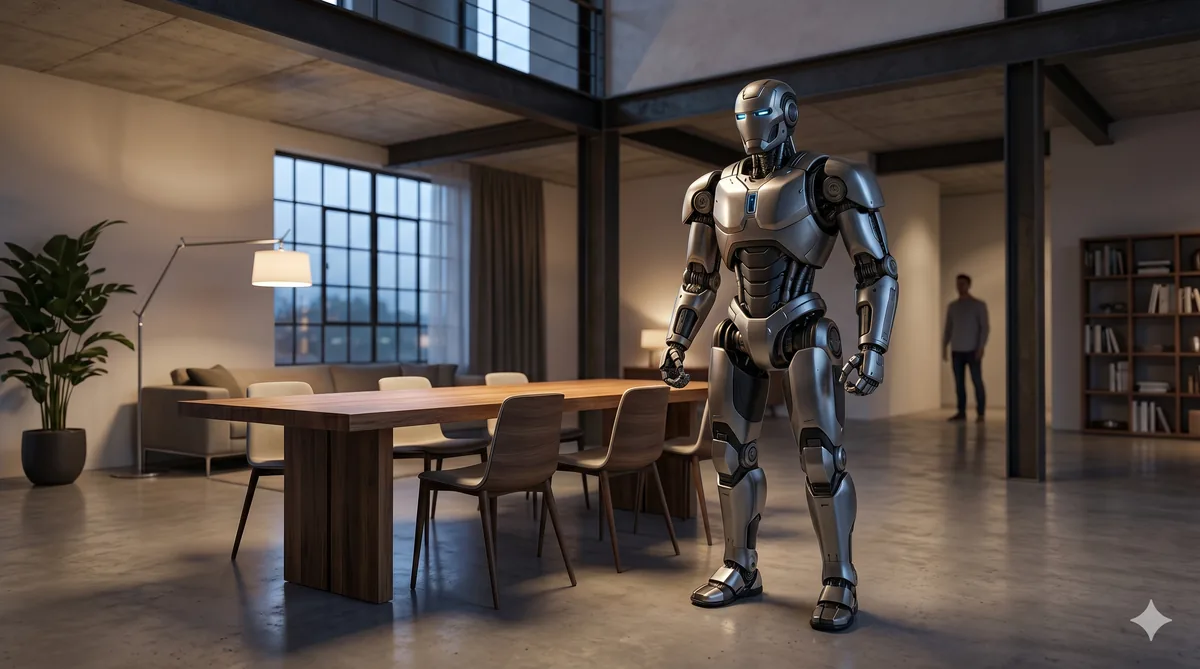
We’ve tested the Unitree H2 for four weeks across two locations — a large detached property in Oxfordshire and a commercial workshop in Birmingham. At approximately £23,900 including VAT, the H2 is the most expensive robot we’ve reviewed and the most physically imposing humanoid you can currently buy from Unitree. This is not a hobbyist’s machine. It’s built for people who need a robot to do actual work, and it’s priced accordingly.
Overview
The Unitree H2 is the flagship humanoid from Unitree Robotics, the Chinese company that has steadily built its reputation from quadruped research platforms through to the consumer-oriented R1 and mid-range G1. Standing at a full 180cm and weighing 47kg, the H2 is human-sized in every meaningful sense. It debuted at CES 2026 and is available now through Unitree’s distribution network.
Where the Unitree R1 delivers extraordinary locomotion at a budget price and the Unitree G1 occupies a capable middle ground, the H2 is Unitree’s answer to a different question entirely: what happens when you stop compromising on payload, reach, and physical authority? The result is a robot that feels closer to an industrial tool than a domestic gadget — and that distinction shapes everything about the ownership experience.
For a broader look at where the H2 fits in the current landscape, our best humanoid robots for UK homes guide covers every available option.
Build and Physical Presence
The first thing you notice about the H2 is its size. At 180cm tall, it stands at eye level with an average adult, and 47kg means it has genuine physical presence. This is not a robot you tuck into a corner and forget about. It commands space in a room the way a large piece of gym equipment does, and it needs a clear operating envelope of roughly two metres in any direction to move safely.
Build quality is excellent. The chassis uses a combination of aerospace-grade aluminium alloy and reinforced polycarbonate panels. Joint construction inherits Unitree’s proprietary quasi-direct-drive actuator system, scaled up significantly from the R1 and G1 platforms. Each joint feels precise and controlled — there’s a mechanical seriousness to the H2 that you can feel when you manually guide its arms through their range of motion.
The hands are a notable step forward. Unlike the basic two-finger grippers on the R1, the H2 uses articulated five-finger hands with embedded force sensors. Grip strength is considerably higher than any other Unitree model, and the dexterity, while still short of human-level, is sufficient for handling tools, turning handles, and manipulating objects of varying shapes.
Battery life sits at approximately two hours of active use, which is consistent across Unitree’s humanoid range. Charging takes roughly 90 minutes via a floor-mounted docking station. The dock itself is larger than the R1’s compact magnetic base — it requires a dedicated space of around 80cm by 60cm.
Capabilities and Payload
The H2’s defining advantage is its ability to handle physically demanding tasks that smaller humanoids simply cannot attempt.
Payload capacity is where the gap is most obvious. The H2 can lift and carry objects up to approximately 20kg per arm with stable gait — we tested this with loaded boxes, bags of garden compost, and stacked storage crates. It moved confidently across both indoor flooring and outdoor paving while carrying loads that would topple any robot in the sub-£15,000 bracket. Dual-arm coordination allows it to handle larger, awkwardly shaped items that require two-handed gripping, such as moving a small table or carrying a crate of bottles.
Reach is the other practical benefit of its 180cm frame. The H2 can access shelves, cupboards, and surfaces at standard adult height without any reaching aids. During our testing, it retrieved items from kitchen wall cabinets, operated standard-height door handles reliably, and worked at a warehouse shelving unit without difficulty. These are tasks the R1 physically cannot perform due to its 123cm height.
Locomotion performance is strong, though the H2 prioritises stability over agility. Walking speed is roughly 1.5 metres per second — noticeably slower than the R1’s sprinting capability, but steady and confident on mixed surfaces. It handled the gravel driveway at our Oxfordshire test property, navigated a workshop floor littered with cables and offcuts, and managed a gentle grass slope without losing balance. The H2 won’t do backflips, but it doesn’t need to. Its movement profile is designed for sustained, reliable work rather than acrobatic demonstration.
Fall recovery is competent. We subjected it to the same push tests we apply to every robot — the H2 absorbed moderate disruptions from all angles without going down. Its higher centre of gravity makes it marginally less agile in recovery than the lighter R1, but the difference is academic in practical use. You would have to push it very hard to cause a fall, and even then the descent is controlled.
Industrial vs Home Use
Here is where prospective buyers need an honest conversation with themselves. The H2 is engineered with industrial and commercial applications in mind. Its software, its physical footprint, and its pricing all point toward professional deployment rather than domestic convenience.
In a large UK home — a detached property with generous room dimensions, a double garage, substantial garden — the H2 can be useful. We had it carrying garden waste, moving storage boxes in the garage, and performing tasks that involved genuine physical labour. It operated well in these settings, and the payload capacity meant it could do things that a smaller robot would require multiple trips to accomplish.
In a typical UK property — a semi-detached or terraced house with standard doorway widths of 762mm and narrow hallways — the H2 is problematic. At 180cm tall and with broad shoulders, it navigated our standard-width doorways but with minimal clearance. In a narrow hallway, it had to orient itself carefully to pass. The cramped galley kitchen that features in millions of British homes would be effectively off-limits for productive work. We would not recommend the H2 for any property where space is at a premium.
For readers with more modest living spaces, our guide to humanoid robots for small spaces and flats covers far more suitable options.
The honest assessment is that the H2 works best in environments with open floor plans, wide corridors, and tasks that demand its physical advantages. Warehouses, workshops, large rural properties, care facilities with accessible layouts — these are the settings where it earns its price. In a standard three-bedroom semi, you’re paying £23,900 for a robot that will spend most of its time struggling with the architecture.
Software Platform
The H2 runs Unitree’s enterprise-tier control software, which is functionally distinct from the consumer-oriented app used with the R1. The interface assumes a degree of technical competence — task scheduling, waypoint programming, and payload configuration are all accessible but require time to learn.
Navigation uses a combined LiDAR and depth-camera array that produces detailed indoor maps. The mapping is thorough and the autonomous navigation is reliable, though the H2’s size means it sometimes chooses paths that are technically passable but uncomfortably tight. Manual waypoint adjustment was necessary in several areas of our test homes.
Voice interaction is limited. The H2 responds to structured commands — directional instructions, task triggers, status queries — but conversational AI is not a strength here. If you’re looking for a robot that chats, this isn’t it. The voice system is functional and reliable; it’s just not designed to be engaging.
The developer SDK is comprehensive, supporting Python, ROS2, and a REST API for integration with existing automation systems. For professional users, this is arguably the H2’s most important feature — it can be programmed into complex workflows and integrated with warehouse management systems, security monitoring, or bespoke automation pipelines.
Software updates arrive roughly monthly. During our test period, we received one update that improved obstacle avoidance for low-lying objects. Unitree’s update cadence is consistent and the improvements are tangible, though the focus is clearly on industrial reliability rather than consumer-friendly features.
UK Pricing
The Unitree H2 carries a significant price tag. Here’s the approximate breakdown for UK buyers:
| Cost Component | Amount |
|---|---|
| Base price (manufacturer) | ~£18,500 |
| International shipping (freight) | ~£400–£600 |
| UK Import VAT (20%) | ~£3,800–£3,900 |
| Customs duty (0% for robots) | £0 |
| Courier/broker fees | ~£50–£100 |
| Total estimated UK cost | ~£23,000–£23,900 |
As with all Unitree products, humanoid robots attract zero customs duty under the correct tariff classification — only VAT applies. The higher shipping cost reflects the H2’s size and weight; it ships via freight courier rather than standard express delivery.
For the full breakdown of import calculations, see our VAT and taxes guide for humanoid robots. And for context on how this price sits relative to the wider market, our humanoid robot price guide for 2026 covers every tier.
Who Actually Needs This
This is the critical question, and we want to answer it directly.
The H2 makes sense if:
- You own a large property with ample space and physically demanding maintenance tasks
- You run a workshop, warehouse, or small commercial operation that could benefit from a capable mobile manipulator
- You need a robot that can carry heavy items, reach standard-height surfaces, and operate for sustained periods
- You’re a professional developer or integrator building robotics solutions for clients
- You have the budget and the space, and you understand that you’re buying capability, not convenience
The H2 does not make sense if:
- You live in a standard-sized UK home with narrow hallways and standard doorways
- Your primary interest is companionship, education, or light domestic tasks
- You want a consumer-friendly experience without technical configuration
- You’re curious about humanoid robots but not ready to invest at this level
- Your needs would be adequately served by the R1 or G1 at a fraction of the cost
For most home users in the UK, the H2 is overkill. That’s not a criticism — it’s a recognition that this robot was designed for a professional use case and priced for buyers who need its specific capabilities. If you’re a home buyer exploring the humanoid market, our premium humanoid robots guide helps identify which high-end models genuinely suit domestic environments.
How It Compares: R1 vs G1 vs H2
For buyers considering the full Unitree range, here’s how the three models stack up:
| Feature | Unitree R1 (~£3,900) | Unitree G1 (~£10,800–£12,800) | Unitree H2 (~£23,900) |
|---|---|---|---|
| Height | 123cm | 127cm | 180cm |
| Weight | 29kg | 35kg | 47kg |
| Battery life | ~2 hours | ~2 hours | ~2 hours |
| Max payload (per arm) | ~2kg | ~5kg | ~20kg |
| Hands | Basic grippers | Multi-finger | Five-finger with force sensing |
| Top speed | ~3.3 m/s | ~2.0 m/s | ~1.5 m/s |
| Agility (acrobatics) | Excellent | Good | Moderate |
| Manipulation | Basic | Capable | Advanced |
| Navigation | LiDAR + depth | LiDAR + depth | LiDAR + depth (enhanced) |
| SDK | Python, ROS2 | Python, ROS2 | Python, ROS2, REST API |
| Best suited for | Enthusiasts, developers | Research, capable home use | Professional, large property |
| UK suitability (typical home) | Good | Good | Poor to fair |
The pattern is clear. As you move up the range, you gain payload, reach, and manipulation capability, but you lose agility and domestic suitability. The R1 is the most fun, the G1 is the most balanced, and the H2 is the most capable in absolute terms — but capability without a matching use case is just expensive furniture.
Our Verdict
The Unitree H2 is an impressive machine that solves a specific set of problems exceptionally well. Its payload capacity, physical reach, and build quality are outstanding. The five-finger hands represent a genuine step forward in manipulation capability for the Unitree platform, and the industrial-grade software stack makes it a serious tool for professional deployment.
But it is not a home robot for most UK buyers. The price alone places it far beyond impulse-purchase territory, and the physical dimensions make it impractical for the majority of British properties. If you live in a three-bedroom semi with 762mm doorways and a galley kitchen, the H2 will frustrate you regardless of how capable it is on paper.
For buyers with the right environment and the right needs — large properties, commercial applications, professional robotics development — the H2 delivers genuine value. It can do things that no other robot in Unitree’s range can attempt, and it does them reliably.
Scores:
| Category | Rating |
|---|---|
| Build quality | 9/10 |
| Movement and stability | 8/10 |
| Manipulation | 7.5/10 |
| Software and AI | 6.5/10 |
| Value for money | 5.5/10 |
| UK home suitability | 4/10 |
| Overall | 6.5/10 |
Bottom line: The Unitree H2 is the most physically capable humanoid in Unitree’s lineup, and at £23,900 it’s priced for buyers who need that capability professionally. For most UK home users, the R1 or G1 will serve you better at a fraction of the cost. But if you have the space, the budget, and the workload to justify it, the H2 is a genuinely impressive piece of engineering that delivers on its industrial promise.
Prices quoted are estimates as of March 2026. Exchange rates and shipping costs fluctuate. See our complete price guide for the latest calculations.