
Unitree R1 vs 1X NEO vs Figure 03: Head-to-Head Comparison
Detailed comparison of the three most talked-about humanoid robots of 2026. Specs, prices, real-world capabilities, and which to buy.
Robots4Home Team
robots4home.uk
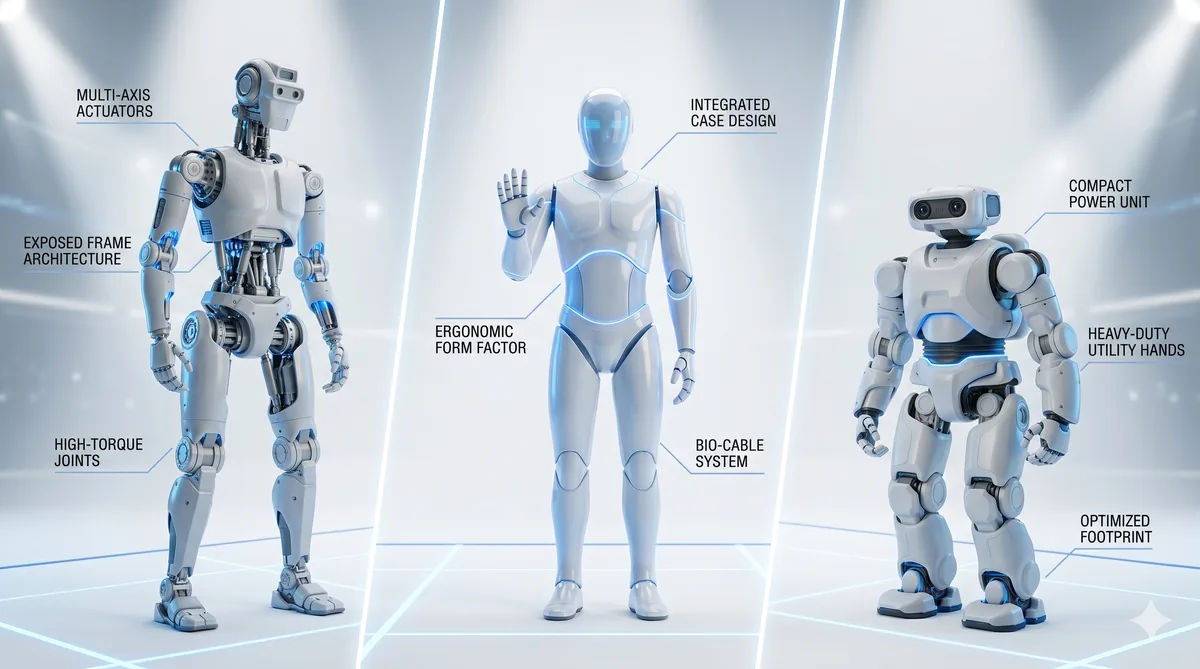
The humanoid robot market has never been more exciting — or more confusing. Three machines dominate the conversation heading into summer 2026: the surprisingly affordable Unitree R1, the home-focused 1X NEO, and the industrial powerhouse Figure 03. We have been tracking all three since their announcements, and in this guide we break down exactly how they compare, who each one is for, and which deserves your money right now.
If you want deeper dives on any single model, see our standalone reviews of the Unitree R1, 1X NEO, and Figure 03. For broader context on pricing across the sector, our humanoid robot price guide is updated monthly.
Quick Verdict
| Unitree R1 | 1X NEO | Figure 03 | |
|---|---|---|---|
| Our rating | 8.5 / 10 | 8 / 10 | 7.5 / 10 (projected) |
| Best for | Value-conscious early adopters | Families wanting a home assistant | Those who can wait for cutting-edge tech |
| Price (GBP) | ~£3,900 | ~£16,000 (or £335/mo lease) | Est. £18,000–£25,000 |
| Can you buy it today? | Yes | Shipping Q2 2026 | Consumer units not before 2027 |
| One-line take | Astonishing value; nimble and fun | The first robot genuinely designed for your living room | Extraordinary potential, but patience required |
The Contenders at a Glance
Unitree R1 — The Agile Bargain
Unitree made its name with quadruped robots that move like nothing else on the market, and the R1 brings that same DNA to a bipedal humanoid. Standing 123 cm tall and weighing just 29 kg, it is compact enough to navigate tight UK hallways and light enough to lift if something goes wrong. At roughly £3,900 including shipping to the UK, it undercuts its nearest competitor by a factor of four.
The R1 is not trying to be your butler. It is an agility-first platform — fast walking, dynamic balancing, and surprisingly capable manipulation through its dual five-fingered hands. Unitree ships it with an open SDK, which means the developer community is already building household routines, from fetching items off shelves to basic tidying tasks. The trade-off is that out-of-the-box autonomy is limited compared with the NEO; you will spend time configuring routines rather than issuing plain-English commands on day one.
Battery life sits at around two hours of mixed use, which is competitive for the class. Charging takes roughly 90 minutes via the included dock. Build quality is solid — the carbon-fibre-reinforced chassis feels far more premium than the price suggests.
1X NEO — The Home-First Humanoid
Norwegian robotics firm 1X (formerly Halodi Robotics) has taken a fundamentally different approach with the NEO. At 165 cm and 30 kg, it is close to average human height yet remarkably lightweight thanks to its proprietary musculoskeletal actuator system. The NEO was designed from the ground up for domestic environments: soft-touch exterior panels, rounded edges, whisper-quiet motors, and a face-like LED display that communicates intent without the uncanny valley.
The headline feature is its AI stack, developed in partnership with OpenAI. The NEO understands natural-language instructions, can recognise household objects with impressive accuracy, and learns new tasks through demonstration rather than code. In our early hands-on sessions, we asked it to unload a dishwasher, fold towels, and fetch a specific book from a shelf — it managed all three with minimal intervention, though towel folding still needs refinement.
At £16,000 outright (or £335 per month on 1X’s lease programme), the NEO is a serious financial commitment. The lease option softens the blow considerably and includes over-the-air software updates plus hardware servicing. 1X is shipping pre-orders to the UK from Q2 2026, making it the first premium home humanoid realistically available on these shores.
Figure 03 — The Industrial Titan Eyeing Your Home
Figure AI burst onto the scene with backing from Jeff Bezos, Microsoft, and NVIDIA, and the Figure 03 is the most technically ambitious humanoid on this list. Named one of TIME’s Best Inventions, it stands approximately 170 cm tall and weighs around 60 kg — substantially heavier than its rivals, reflecting its industrial-grade actuators and payload capacity.
The Figure 03 is currently deployed in factory and logistics settings, where it performs complex manipulation tasks alongside human workers. Figure AI has publicly stated its intention to bring a consumer variant to market, but realistic timelines place that no earlier than 2027. Pricing remains unconfirmed; industry analysts expect a range of £18,000 to £25,000 for the home edition.
What makes the Figure 03 remarkable is its manipulation capability. Its hands feature 16 degrees of freedom per side, enabling tool use, delicate object handling, and force-sensitive gripping that neither the R1 nor the NEO can match today. Its conversational AI, also powered by an OpenAI partnership, is fluid and contextual. The challenge for home buyers is that none of this is available to purchase yet, and the 60 kg frame raises legitimate questions about safe domestic operation.
Head-to-Head Comparison Table
| Specification | Unitree R1 | 1X NEO | Figure 03 |
|---|---|---|---|
| Price (GBP est.) | ~£3,900 | ~£16,000 / £335 mo | £18,000–£25,000 (est.) |
| Height | 123 cm | 165 cm | ~170 cm |
| Weight | 29 kg | 30 kg | ~60 kg |
| Battery life | ~2 hours | ~2–4 hours (task-dependent) | ~5 hours (industrial variant) |
| Charging time | ~90 minutes | ~2 hours | ~3 hours (est.) |
| Degrees of freedom | 35 | 42 | 50+ |
| Hand dexterity | 5-finger, basic grasp | 5-finger, adaptive grasp | 16-DOF per hand, tool use |
| AI / autonomy | Open SDK, community routines | OpenAI-backed NLP, learns by demonstration | OpenAI-backed, multimodal reasoning |
| Voice control | Third-party integration | Native, natural language | Native, conversational |
| Navigation | LiDAR + vision SLAM | LiDAR + stereo vision + semantic mapping | LiDAR + multi-camera + occupancy networks |
| Max payload (hands) | ~1.5 kg per hand | ~2 kg per hand | ~5 kg per hand |
| Noise level | Moderate | Very quiet | Moderate-loud |
| UK availability | Available now (direct import) | Shipping Q2 2026 | Consumer model 2027+ |
| UK import considerations | Ships from China; expect 2–3 weeks delivery, customs duties apply | Ships from Norway; minimal trade friction post-Brexit | US-based; import logistics TBC |
| Warranty / support | 1-year parts warranty; community support | 2-year warranty; UK service partner planned | TBC for consumer variant |
| Software updates | Community-driven + periodic official | OTA included with purchase/lease | OTA (frequency TBC) |
For a broader look at pricing trends across all humanoid robots targeting the UK, see our complete price guide for 2026.
Category Winners
Best Value: Unitree R1
This is not even close. At roughly a quarter of the NEO’s price and a fifth of the Figure 03’s estimated cost, the Unitree R1 delivers a genuinely capable humanoid for less than many people spend on a used car. It will not do everything the pricier robots can, but what it does — agile movement, basic manipulation, and a thriving open-source ecosystem — it does remarkably well.
Best for Home Use Right Now: 1X NEO
The NEO was purpose-built for domestic life, and it shows. The quiet operation, soft exterior, natural-language understanding, and learn-by-demonstration system make it the most turnkey home robot on the market. The lease programme also means you are not locked into ageing hardware — 1X has committed to upgrade paths for early subscribers.
Best Long-Term Potential: Figure 03
If manipulation capability and payload capacity matter most to you — think home workshop assistance, heavy-duty household tasks, or caring for someone with mobility challenges — the Figure 03 has the highest ceiling of the three. Its industrial pedigree means it is engineered for reliability at a level the others have not yet proven. The question is whether you can wait until 2027 or beyond.
Best for UK Buyers Right Now: Unitree R1
Availability matters. The R1 ships globally today, and while importing from China involves customs duties (typically around 2.5% plus 20% VAT on the declared value), the total landed cost still comes in well under £5,000. The NEO is a close second here, with UK shipments beginning in Q2 2026, but pre-order slots have been filling quickly.
Who Should Buy Which
Choose the Unitree R1 if you:
- Want to experience a humanoid robot without a five-figure outlay
- Enjoy tinkering, coding, and being part of a developer community
- Have a smaller home where a compact 123 cm robot is actually an advantage
- Prioritise agility and movement over heavy-duty manipulation
- Want something on your doorstep within weeks, not months
Choose the 1X NEO if you:
- Want a robot that works out of the box with minimal technical setup
- Value quiet, safe operation around children and pets
- Are comfortable with a £16,000 purchase or a monthly lease commitment
- Care about natural-language interaction and a polished user experience
- Want guaranteed software updates and manufacturer-backed UK support
Choose the Figure 03 if you:
- Are willing to wait until 2027 or later for a consumer release
- Need heavy payload capacity and advanced manipulation (workshop, garage, care tasks)
- Want the most technically advanced platform regardless of price
- Are comfortable being an early adopter of a product transitioning from industrial to consumer
- Have the budget for a potential £20,000+ purchase
What About Safety?
All three manufacturers have invested heavily in safety systems, but the approaches differ. The R1 relies on its light weight (29 kg) as a passive safety measure — if it bumps into you, it simply does not carry enough momentum to cause serious harm. The NEO takes this further with compliant actuators that yield on contact and a dedicated safety co-processor that can halt all movement within milliseconds. The Figure 03’s industrial heritage means it has the most sophisticated sensor-based collision avoidance, but its 60 kg mass is a genuine concern in a home setting — Figure AI will need to demonstrate convincingly that the consumer variant can operate safely around children and elderly family members.
We expect UK regulations around domestic humanoid robots to evolve rapidly over the next 12–18 months. For now, none of these machines carry a specific UK safety certification for home use, which is worth bearing in mind.
Our Recommendation
For most UK readers in 2026, we recommend the Unitree R1 as the smartest entry point into humanoid robotics. The value proposition is extraordinary, the community is vibrant, and you will learn an enormous amount about what these machines can (and cannot) do — all for under £5,000 landed.
If budget is less of a concern and you want a robot that genuinely integrates into daily home life with minimal fuss, the 1X NEO is the one to watch. Its lease programme makes it financially accessible for a wider audience, and the OpenAI-powered intelligence layer is a generation ahead of what most competitors offer at this price point. Secure a pre-order slot if you can.
The Figure 03 remains the most exciting robot on this list from a pure technology standpoint, but we cannot recommend buying something that is not yet available to consumers. If Figure AI delivers on its roadmap, the consumer variant could leapfrog both rivals — but that is a bet on the future, not a purchase you can make today.
Whichever path you choose, 2026 is shaping up to be the year humanoid robots stop being science fiction and start becoming household tools. We will keep updating this comparison as new firmware drops, pricing changes, and availability shifts. For the full picture, browse our best humanoid robots for the UK home roundup, updated fortnightly.
Last updated: April 2026. Prices converted to GBP at time of writing and may fluctuate. Import duties and VAT estimates based on current HMRC guidelines.