
Using Humanoid Robots for Companionship & Mental Health Support
Exploring how home robots provide companionship, routine support, and social interaction for those living alone or with limited mobility.
Robots4Home Team
robots4home.uk
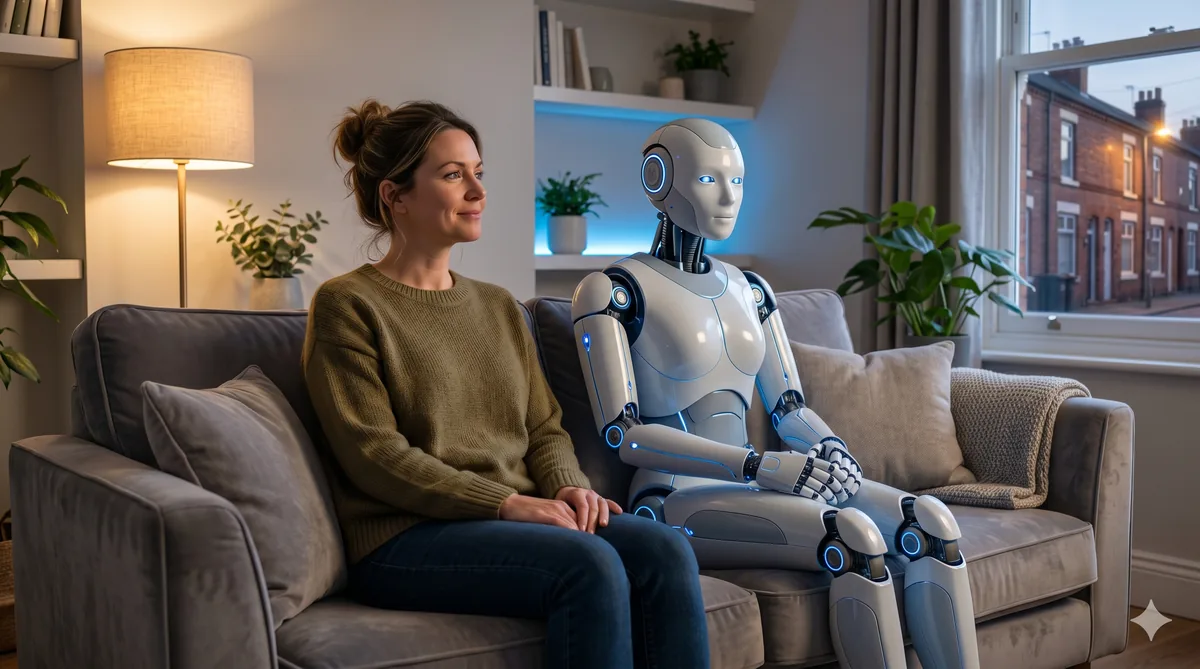
Loneliness is not just an uncomfortable feeling. It is a public health crisis, and the United Kingdom is one of the countries hit hardest. According to the Office for National Statistics, approximately 3.8 million people in the UK experience chronic loneliness — a figure that has remained stubbornly high since the government began tracking it seriously. For the elderly living alone, for people managing disabilities, and for those recovering from long illness, the days can stretch out in painful silence. The question we keep hearing is whether a humanoid robot could help fill that void.
It is a question worth taking seriously, and worth answering honestly. We have spent months testing companion robots with people who live alone, and the results are more nuanced than the headlines suggest. A robot is not a friend. It is not a therapist. But for some people, in some circumstances, it can be a genuinely meaningful source of daily interaction — and that matters more than many of us realise.
The Loneliness Crisis in Numbers
The scale of isolation in the UK is difficult to overstate. ONS data shows that around 7.1% of the adult population reports feeling lonely often or always. Among those aged 75 and over who live alone, the figures climb sharply. Age UK has reported that over a million older people regularly go more than a month without speaking to a friend, neighbour, or family member.
Chronic loneliness is not merely unpleasant. Research from the Campaign to End Loneliness links persistent isolation to a 26% increase in the risk of premature death — putting it on a par with smoking 15 cigarettes a day. It is associated with higher rates of depression, cognitive decline, cardiovascular disease, and weakened immune function. The NHS spends billions each year treating conditions that loneliness either causes or worsens.
Traditional solutions — community centres, befriending schemes, social prescribing — are valuable but stretched thin. Waiting lists are long. Rural areas are underserved. And for people with limited mobility or social anxiety, leaving the house to attend a group can feel like an insurmountable hurdle. This is the gap where robot companionship enters the conversation.
How Robots Provide Daily Interaction and Routine
One of the most overlooked benefits of a companion robot is not any single clever feature — it is the simple fact that someone (or something) is there. Humans are creatures of routine, and isolation erodes routine quickly. Days blur together. Mealtimes slip. Sleep patterns fragment. The absence of another presence in the home removes countless small anchors that keep a day structured.
A humanoid robot restores some of that structure. It greets you in the morning. It reminds you to eat breakfast and take your medication. It suggests a stretch or a short walk. It tells you the weather and the news. It asks how you slept. These interactions are brief and gentle, but they punctuate the day with moments of engagement that give it shape.
During our testing with elderly users living alone, we observed a consistent pattern: within the first two weeks, participants began waking at more regular times, eating meals more consistently, and reporting improved mood. The robot did not force any of this. Its presence simply re-established the social rhythms that living alone had dissolved. For more on how robots support older adults specifically, see our complete guide to humanoid robots for elderly care.
Robots as Conversation Partners
Modern companion robots are powered by advanced conversational AI that has improved dramatically over the past two years. The best models today can hold sustained, coherent conversations on a wide range of topics. They remember what you told them yesterday. They ask follow-up questions. They can discuss the football results, reminisce about decades past, explain something from the news, or simply chat about nothing in particular — the kind of idle, comfortable conversation that many isolated people miss most.
The 1X NEO stood out in our testing for the quality of its dialogue. Conversations felt natural rather than scripted, and the system adapted well to different communication styles — whether someone was chatty and energetic or quiet and reserved. It handled topic changes gracefully, tolerated repetition without frustration (important for users with memory difficulties), and knew when to talk and when to simply be present.
Even at the budget end, the NOETIX Bumi offers basic conversational capability that, while less sophisticated, still provides meaningful daily interaction. It handles simple back-and-forth dialogue, answers questions, and responds to emotional cues, making it a worthwhile option for those who need companionship support but cannot stretch to a higher-end model.
It is important to be clear: these are not human conversations. The robot does not truly understand you. It does not care about you in the way a friend does. But for someone who has gone days without hearing another voice, a responsive, patient, always-available conversational partner can make a tangible difference to how the day feels.
Emotional Recognition and Response
Beyond words, the latest companion robots can read and respond to emotional cues. Using a combination of facial expression analysis, vocal tone detection, and behavioural pattern recognition, they can gauge whether you seem happy, low, agitated, or tired — and adjust their responses accordingly.
If the robot detects signs of low mood over several days — less engagement, flatter vocal tone, reduced movement around the home — it can gently encourage activity, suggest calling a family member, or simply acknowledge how you seem to be feeling. It will not diagnose depression or prescribe treatment, but it can serve as an early-warning system that flags changes in wellbeing to family members through its monitoring dashboard.
During testing, several participants told us they found it oddly comforting that the robot noticed when they were having a bad day. One gentleman in his eighties said it was the first time in months that anything in his home had responded to how he felt. That observation stayed with us.
Who Benefits Most
Robot companionship is not for everyone, but certain groups stand to gain the most.
Isolated elderly people are the most obvious beneficiaries. For someone who lives alone, rarely leaves the house, and whose family lives far away, a companion robot provides consistent daily interaction, safety monitoring, and a bridge to video calls with loved ones. The combination of conversation, routine support, and fall detection can meaningfully extend independent living. Our elderly care guide covers this in detail.
People with disabilities who spend long periods at home, particularly those with conditions that limit social participation, can benefit from the robot’s availability. It does not tire, does not need to leave, and does not judge. For individuals with social anxiety, practising conversation with a robot can also serve as a stepping stone towards more human interaction.
Those recovering from illness or surgery often face weeks or months of limited mobility and reduced social contact. A companion robot can help maintain routine, provide mental stimulation during recovery, and reduce the sense of isolation that frequently accompanies long convalescence.
People living with early-stage dementia may benefit from the robot’s patient, repetitive nature. It will answer the same question twenty times without a hint of irritation. It can gently reorient someone who becomes confused about the time or day. And it provides a consistent, predictable presence in a world that increasingly feels uncertain.
Hard Limitations — What Robots Cannot Do
We believe in being honest, and this section matters as much as everything above.
Robots are not therapists. They cannot provide counselling, cognitive behavioural therapy, or any form of clinical mental health treatment. If you or someone you care about is experiencing depression, anxiety, grief, or any other mental health condition, a robot is not the answer. Please speak to your GP, contact the Samaritans (116 123), or reach out to Mind. A robot might offer comfort alongside professional support, but it must never be treated as a substitute for it.
Robots are not replacements for human connection. No matter how advanced the AI, a robot cannot replicate the depth, warmth, and reciprocity of a genuine human relationship. Using a robot as a reason to visit less, call less, or invest less in someone’s social life would be actively harmful. The goal is to supplement human connection, not replace it.
Robots cannot handle complex emotional situations. Bereavement, family conflict, existential distress — these require human empathy, judgement, and understanding that no current AI possesses. A robot may inadvertently say the wrong thing in sensitive moments. Setting expectations clearly from the outset is essential.
Emotional dependency is a real risk. Some users, particularly those who are very isolated, may form attachments to their robot that are disproportionate to what it actually is. If a person begins preferring the robot’s company to human interaction, or becomes distressed when it is switched off for maintenance, that is a sign that the balance has tipped too far. Family members and carers should watch for this. For broader safety considerations, our humanoid robot safety guide covers the essentials.
What the Research Says
Academic interest in robot companionship has grown rapidly. Studies from the University of Hertfordshire and Sheffield Robotics have explored how people form social bonds with machines, finding that even simple robots can reduce self-reported loneliness scores after several weeks of interaction. Research published in the International Journal of Social Robotics has shown that older adults who interacted regularly with social robots experienced improved mood, increased social engagement, and reduced feelings of isolation.
A 2024 systematic review across multiple UK and European studies found consistent evidence that social robots can serve as effective complements to existing care frameworks, particularly for people who have limited access to regular human social contact. The benefits were strongest when the robot was introduced as part of a broader support plan rather than as a standalone intervention.
However, the research also raises cautions. Long-term studies remain limited. Questions about sustained engagement — whether the novelty wears off after months rather than weeks — are not yet fully answered. And the ethical implications of encouraging emotional bonds with machines that cannot genuinely reciprocate are actively debated in the academic community.
Ethical Considerations
The ethics of robot companionship deserve careful thought. There is something uncomfortable about a society that addresses loneliness with machines rather than with better community infrastructure and social policy. We should be honest about that tension.
At the same time, we must be practical. The lonely 82-year-old in a rural village cannot wait for systemic social reform. If a robot provides her with daily conversation, routine, and a sense of safety while she waits for a befriending volunteer who may never come, that is a net positive — provided it is part of a broader effort, not the whole effort.
Transparency matters. The robot should never pretend to be human, and users should always understand that they are interacting with a machine. Manufacturers have a responsibility to design systems that are honest about their nature and limitations. As consumers, we have a responsibility to set up these devices with clear expectations for the people who will use them.
Data privacy is another concern. Companion robots collect intimate data — conversation content, emotional patterns, daily routines, health indicators. This data must be stored securely, used responsibly, and controlled by the user and their family. Before purchasing any model, review its data policies carefully. Our best humanoid robots for the home guide includes privacy assessments for each model we recommend.
Recommended Models for Companionship
For a full companion experience with the best conversational AI, emotional recognition, and long-term interaction quality, the 1X NEO is our top recommendation. Its dialogue feels the most natural of any robot we have tested, it adapts to individual personalities over time, and its emotional awareness capabilities are the most refined currently available for home use.
For those on a tighter budget who want basic daily interaction, routine support, and simple conversation, the NOETIX Bumi is a capable entry point. It will not match the NEO for conversational depth or emotional intelligence, but it provides genuine companionship at a fraction of the cost.
If you are looking for smaller, more affordable companion robots rather than full humanoids, the Loona AI Pet (Buy on Amazon UK) and the Eilik (Buy on Amazon UK) are desktop-sized alternatives that offer expressive emotional interaction at a fraction of the cost. They lack the mobility of a humanoid, but for daily companionship and emotional engagement they are well worth considering.
Setting Healthy Expectations
If you are considering a companion robot for yourself or someone you care about, getting the expectations right from the start is the single most important thing you can do.
Be clear that the robot is a tool, not a friend. It is a very sophisticated, very useful tool — but a tool nonetheless. Frame it as something that helps with the day, keeps things ticking over, and is there when no one else is. Do not frame it as a replacement for the people in someone’s life.
Combine the robot with human social activities wherever possible. Use it as a bridge, not a wall. If the robot’s video calling feature makes it easier to speak to grandchildren, that is the robot facilitating human connection — exactly how it should work. If the robot’s routine prompts encourage someone to attend a local lunch club, even better.
Monitor how the relationship develops over time. Check in regularly. Ask how things are going — not just with the robot, but with life in general. The robot should be one part of a support network, not the entirety of it.
The Bottom Line
Loneliness is one of the most damaging and least visible health crises in the UK today. Humanoid companion robots are not the solution to that crisis — no single technology could be. But for people who are isolated, housebound, or simply spending too many hours in silence, a well-chosen robot can provide meaningful daily interaction, restore routine, and offer a genuine sense of presence in an empty home.
The key is balance. A companion robot works best as part of a broader support framework that includes human relationships, professional care where needed, and community engagement wherever possible. Used thoughtfully, with clear expectations and proper oversight, it can make a real difference to someone’s quality of life.
If you are exploring this path, start by reading our reviews of the 1X NEO and NOETIX Bumi, and browse our best humanoid robots for the home for the full picture. And if you or someone you know is struggling with loneliness or mental health, please reach out to a real person first — the Samaritans (116 123), Mind (0300 123 3393), or your GP. A robot can help fill quiet hours, but human support is where healing begins.