
Home Security with Humanoid Robots: Surveillance & Protection
Can a humanoid robot improve your home security? We explore monitoring, patrol routines, camera integration, and alert systems.
Robots4Home Team
robots4home.uk
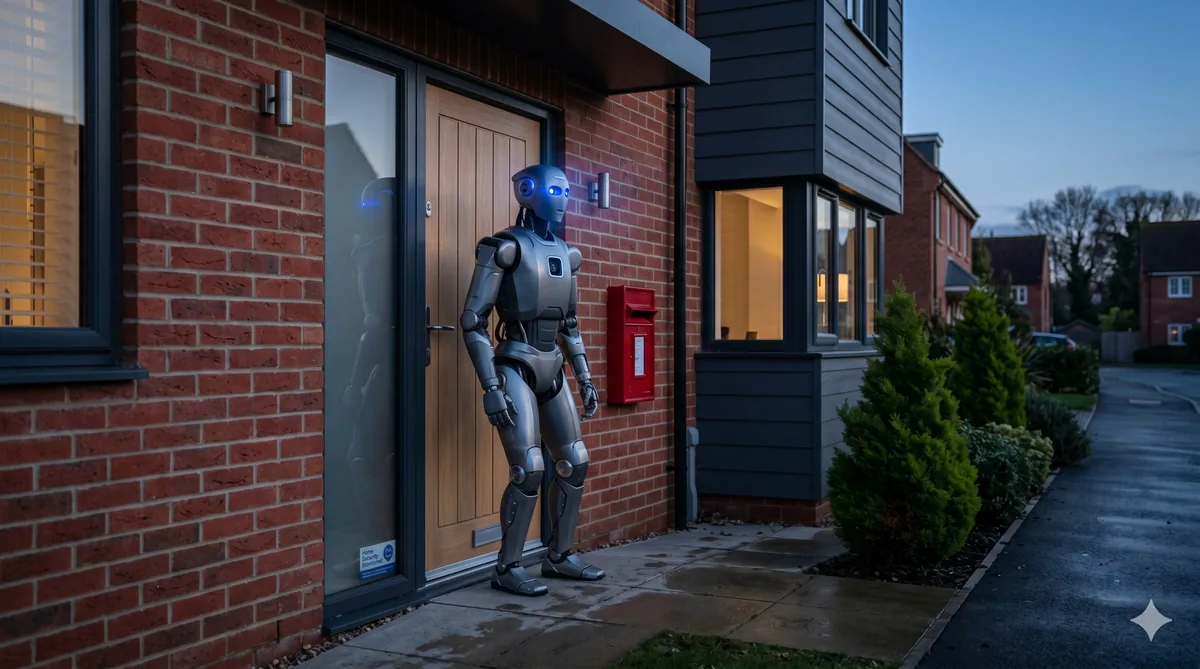
The idea of a robot patrolling your home while you sleep or while you are away on holiday is undeniably appealing. With built-in cameras, motion sensors, and the ability to send alerts straight to your phone, consumer humanoid robots and robot dogs are increasingly being marketed as security devices. But can they genuinely protect your home, or is this more science fiction than practical reality?
We have spent considerable time testing robots in domestic settings, and in this guide we give you an honest breakdown of what they can and cannot do for home security. If you are exploring different ways robots might fit into your life, our complete use-case guide covers everything from companionship to household chores.
What Security Capabilities Do Robots Actually Offer?
Modern consumer robots come equipped with a surprisingly capable sensor suite. Most humanoid robots and quadruped robot dogs include wide-angle RGB cameras, depth sensors, and in some cases infrared or night-vision modules. Here is what that translates to in practice:
Live and recorded camera feeds. Robots like the Unitree G1 and H1 can stream video to a companion app on your phone or tablet. You get a mobile viewpoint that a fixed CCTV camera simply cannot replicate — the robot can move from room to room, checking angles that a wall-mounted camera would miss entirely.
Programmable patrol routines. Several robots allow you to set scheduled patrol routes through your home. You can define waypoints so the robot walks a circuit of your ground floor at set intervals overnight, or sweeps through the house once an hour while you are at work. The Unitree Go2 robot dog is particularly well-suited to this, handling doorways, corridors, and even gentle slopes with reliable footing.
Motion and anomaly detection. Using onboard sensors, robots can detect unexpected movement or sounds. When something triggers the detection threshold, the robot can capture footage and push an alert notification to your phone within seconds. Some models also support two-way audio, allowing you to speak through the robot’s speaker to challenge an unexpected visitor.
Integration with phone alerts. Nearly all current consumer robots support push notifications via their companion apps. You can receive instant alerts with snapshot images or short video clips, giving you eyes on your home from anywhere with a mobile signal.
These are genuine, functional capabilities. But they come with significant caveats that any honest assessment must address.
The Limitations You Need to Understand
We would be doing you a disservice if we let you believe a robot could replace a proper security system. Here are the hard truths:
Robots cannot physically stop an intruder. A humanoid robot standing in your hallway is not going to restrain a burglar. Current consumer robots lack the strength, the programming, and — critically — the legal authority to physically intervene. They are observers, not bouncers.
Movement speed is a real constraint. Most humanoid robots walk at roughly 1 to 3 kilometres per hour in a domestic setting. The Unitree G1, for example, moves cautiously indoors to avoid collisions with furniture. A determined intruder would be through your house and gone long before the robot finished its patrol route. Robot dogs like the Go2 are faster and more agile, but they still cannot chase anyone down.
Battery life limits patrol duration. A typical patrol-capable robot runs for one to three hours on a single charge. Unless you position a charging dock along the patrol route, your robot security guard is going to clock off halfway through the night.
They are noisy. Servo motors and actuators are not silent. A patrolling robot announces its presence, which arguably defeats the purpose of catching an intruder off-guard — though one could argue the noise itself acts as a mild deterrent.
How Do Robots Compare with Traditional Security Systems?
Traditional home security — CCTV cameras, alarm systems, motion-activated lighting, monitored alarm services — has decades of refinement behind it. Here is how robots stack up:
| Feature | Traditional Security | Robot Security |
|---|---|---|
| Coverage | Fixed cameras, multiple angles | Mobile, but one viewpoint at a time |
| Reliability | 24/7, mains-powered | Battery-limited, needs recharging |
| Response time | Alarm triggers instant response | Alert sent, but robot cannot intervene |
| Deterrence | Visible cameras, alarm boxes, sirens | Robot presence, two-way audio |
| Cost | From around GBP 150 for a basic system | From GBP 1,500+ for a capable robot |
| Monitoring | Professional monitoring available | Self-monitored via app only |
| Outdoor coverage | Weatherproof cameras standard | Most robots are indoor-only |
The comparison is not flattering for robots. A GBP 200 Ring doorbell and a couple of indoor cameras will give you better coverage, better reliability, and professional monitoring options for a fraction of the price. For a thorough look at what is available and what each robot actually costs, see our buyer’s guide to robots you can purchase in the UK.
Which Robots Work Best for Security Patrols?
If you are set on incorporating a robot into your security setup, some models are better suited than others:
Unitree G1 — compact enough for indoor use, equipped with decent cameras, and capable of following pre-programmed routes. It handles flat surfaces and standard doorways well, making it a reasonable indoor patrol option.
Unitree Go2 robot dog — in our view, this is the stronger choice for security purposes. Its quadruped design gives it far better stability on uneven ground, steps, and outdoor surfaces like patios and garden paths. If you want something that can patrol both indoors and in a sheltered outdoor area, the Go2 is the robot we would recommend. It is also faster and more agile than any humanoid option currently on the market.
Unitree H1/R1 — the larger humanoid platforms offer better camera positioning (higher vantage point) but are overkill for most domestic security applications and far more expensive. For a detailed comparison, check our best humanoid robots for UK homes roundup.
Integrating Robots with Your Smart Home Security
Where robots become more interesting is as part of a layered security ecosystem rather than a standalone solution. If you already use smart home security products — Ring doorbells and cameras, Hive smart sensors, Yale smart locks — a robot can fill gaps in your coverage.
For example, you might have Ring cameras covering your front door and back garden, but no coverage of your garage, side passage, or upstairs landing. A robot patrolling those areas on a schedule adds mobile monitoring where fixed cameras are impractical.
Some integration scenarios we have found useful:
- Robot detects motion indoors and triggers a smart home routine that activates all Ring cameras to record, switches on smart lighting throughout the house, and sends you a consolidated alert.
- Yale smart lock reports an unexpected unlock, and the robot navigates to the entry point to capture footage of whoever has come in.
- Hive sensors detect a window opening at night, prompting the robot to move to that room and begin streaming live video to your phone.
These integrations typically require a central smart home hub or platform like Home Assistant, as direct robot-to-Ring or robot-to-Yale communication is still limited. We cover the technical setup in detail in our smart home integration guide.
Privacy, GDPR, and Legal Considerations
A robot with cameras patrolling your home raises important privacy questions, particularly under UK GDPR and data protection law.
Inside your own home, you are generally free to record footage for personal security purposes. However, if your robot’s cameras capture footage of visitors, guests, or anyone who enters your property, you should be aware of your obligations. Under ICO guidance, domestic CCTV that captures images beyond the boundary of your private property (for instance, a pavement or a neighbour’s garden) may bring you within the scope of data protection legislation.
Data storage matters. If your robot uploads footage to a cloud server — particularly one hosted outside the UK — you need to consider where that data is going and who has access. Check the manufacturer’s privacy policy carefully. Some Chinese-manufactured robots route data through servers in mainland China, which may concern privacy-conscious users.
Inform visitors. It is good practice to let anyone entering your home know that a robot with cameras is operating. A simple notice near your front door is sufficient and keeps you on the right side of privacy expectations.
For a fuller discussion of the legal landscape, including liability questions if a robot were to cause injury during a patrol, see our UK regulations and legal guide.
Will a Security Robot Affect Your Home Insurance?
This is a question we get asked frequently, and the honest answer is: probably not, at least not yet. Most UK home insurers do not currently recognise a consumer robot as a security device for the purposes of policy discounts. You will not get the premium reduction you might see for installing a monitored alarm system or British Standard-rated locks.
That said, having any form of recorded surveillance can help with claims. If a robot captures footage of a break-in, that evidence could support an insurance claim. Just do not expect your insurer to lower your premium because you have a robot dog walking laps of your living room.
Our Honest Verdict
We genuinely enjoy testing these robots, and the security features they offer are real and improving with every generation. But we would not recommend anyone rely on a robot as their primary home security system.
Dedicated security systems are simply better at the job. They are more reliable, cheaper, offer professional monitoring, work around the clock without recharging, and are proven technology that insurers and police recognise. A Ring or Hive setup with a monitored alarm will protect your home more effectively than any consumer robot currently on the market.
Where robots add value is as a supplement. Think of them as a mobile camera you can send to investigate a noise, an extra set of eyes on areas your fixed cameras do not cover, or a visible presence that might give a casual opportunist second thoughts. Paired with a proper security system and smart home integration, a robot can genuinely enhance your overall setup.
But a replacement for your alarm system? Not yet. Perhaps not for quite some time. Invest in proven security first, and treat the robot as a bonus layer — one that happens to also carry your shopping, entertain the children, and remind you to take the bins out.