
LG CLOiD Review: South Korea's Home Robot in the UK Market
LG's CLOiD promised a 'Zero Labour Home' at CES 2026. We look at what's real, what's coming, and when UK buyers can get one.
Robots4Home Team
robots4home.uk
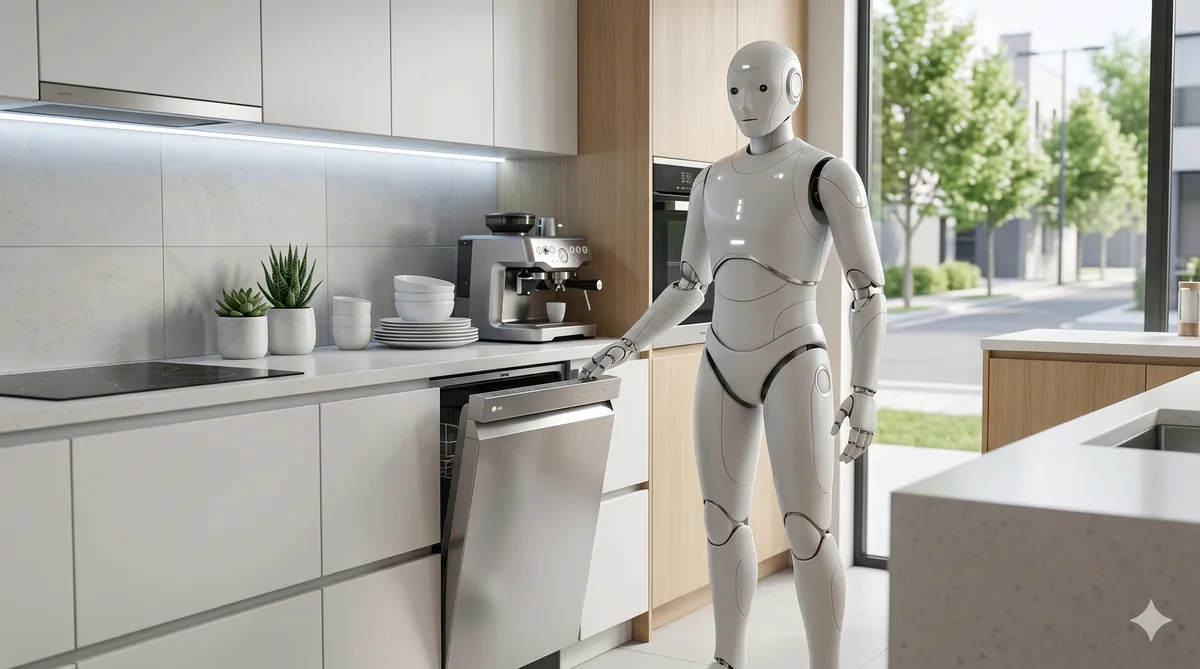
This is a preview article, not a hands-on review. LG’s CLOiD is not available to purchase anywhere in the world at the time of writing. Everything below is based on LG’s CES 2026 presentation, official press materials, and our analysis of the broader home robotics landscape. We will update this article as more details emerge.
At CES 2026 in January, LG made one of the most ambitious announcements we have seen from a major consumer electronics company. Alongside a sweeping vision it calls the “Zero Labour Home,” LG unveiled CLOiD — a humanoid home robot designed to handle domestic chores, manage smart home devices, and serve as the physical centrepiece of an entirely automated household. It was a bold statement of intent from a company better known for televisions and refrigerators, and it immediately placed LG alongside the likes of 1X Technologies, Tesla, and Figure in the race to bring humanoid robots into our homes.
But bold announcements and working products are very different things. We have been tracking the home robotics space closely — see our guide to the best humanoid robots for UK homes — and we know that the gap between a dazzling CES demo and a robot you can actually buy tends to be measured in years, not months. So what did LG actually show, and when might UK consumers realistically get their hands on a CLOiD?
What LG Showed at CES 2026
LG’s CES presentation featured CLOiD performing a range of household tasks on a purpose-built stage designed to resemble a modern living space. The robot was shown navigating between rooms, picking up and organising objects, carrying drinks to a seated person, and interacting with LG smart home appliances — adjusting the thermostat, starting a washing cycle, and checking the contents of a smart refrigerator.
The physical design is notably different from the slender, lightweight approach taken by competitors like 1X with the NEO. CLOiD appears more compact and solidly built, with a form factor that suggests LG has prioritised stability and payload capacity over agility. The hands shown in demos featured multi-fingered grippers capable of handling everyday objects — cups, folded clothing, remote controls — though the level of fine dexterity was difficult to assess from stage demonstrations alone.
LG also demonstrated voice interaction, with CLOiD responding to natural language commands and carrying on short conversational exchanges. The AI powering these interactions reportedly builds on LG’s existing work in natural language processing, though the company has not disclosed whether it is partnering with an external AI provider or relying entirely on in-house models.
It was an impressive presentation. But it is worth noting that CES demos are carefully choreographed, and we have no independent verification of how reliably CLOiD performs these tasks in uncontrolled environments.
The “Zero Labour Home” Concept
CLOiD is not a standalone product in LG’s vision — it is the physical agent within a much broader ecosystem that LG calls the “Zero Labour Home.” The concept imagines a household where connected appliances, sensors, and a central AI coordinate seamlessly, with CLOiD acting as the mobile element that bridges the gaps between fixed devices.
In practice, this means CLOiD would not just tidy your living room — it would check your smart fridge, add items to your shopping list, load the dishwasher, transfer laundry between the washer and dryer, and adjust climate settings based on occupancy patterns. The robot becomes the hands of a house-wide intelligence system.
This is a genuinely compelling vision, and it plays to LG’s strengths. Unlike pure robotics startups, LG already manufactures the appliances that would form the ecosystem around CLOiD. If you already own LG white goods managed through the ThinQ platform, CLOiD could theoretically integrate with your existing setup more naturally than a standalone robot from a company that does not make washing machines.
For readers interested in how robots work alongside smart home systems, our guide to integrating robots with your smart home explores this topic in depth.
Known Specs and Capabilities
LG has been selective about the technical details it has released. Based on what has been disclosed and demonstrated, here is what we know:
- Form factor: Humanoid, shorter and more compact than most competitors, designed for indoor domestic use
- Manipulation: Multi-fingered hands capable of grasping and carrying household objects
- Navigation: Autonomous movement through home environments, including doorways and between rooms
- Smart home integration: Native connectivity with LG ThinQ ecosystem, including appliances, lighting, and climate control
- Voice interaction: Natural language command processing and conversational responses
- AI backbone: On-device and cloud-based intelligence (specific architecture not disclosed)
- Task range: Tidying, fetching, carrying, appliance operation, and household management demonstrated at CES
What has not been disclosed is equally telling. We have no confirmed figures for battery life, weight, maximum payload, degrees of freedom, or processing specifications. We also have no information about whether CLOiD will require teleoperator support for complex tasks — a dependency that currently defines the 1X NEO experience.
LG ThinQ Integration — The Potential Advantage
The single most interesting aspect of CLOiD is not the robot itself — it is the ecosystem around it. LG’s ThinQ platform already connects millions of appliances worldwide, and the company has spent years building out the software infrastructure for inter-device communication.
If LG executes this properly, CLOiD could arrive with a level of smart home integration that would take a standalone robotics company years to develop through third-party partnerships. Imagine telling CLOiD to handle the laundry and having it coordinate with your LG washer-dryer directly, or asking it to prepare for guests and having it adjust lighting, temperature, and even start your LG oven’s preheat cycle.
This is a meaningful differentiator. Most home humanoid robots today operate as isolated agents — they can tidy a room but they cannot talk to your boiler. CLOiD, at least in theory, could be the first home robot that genuinely orchestrates an entire household.
The caveat is obvious: this ecosystem advantage only exists if you are invested in LG appliances. For households running a mixed ecosystem of brands, CLOiD’s integration advantage shrinks considerably.
Estimated UK Pricing
LG has not announced pricing for CLOiD. Based on the current home humanoid market, our best estimate places CLOiD somewhere in the £10,000 to £20,000 range for UK buyers.
This estimate is informed by several factors. The 1X NEO is priced at roughly £16,000, the Unitree R1 sits around £10,000-£12,000, and Tesla has suggested Optimus could eventually reach a lower price point. LG, as a major consumer electronics manufacturer with existing supply chains and manufacturing scale, could theoretically undercut pure robotics startups — but the R&D costs for a first-generation humanoid robot are enormous, and early units are unlikely to be cheap.
Our humanoid robot price guide for 2026 provides a comprehensive comparison of pricing across all announced models if you want to see where CLOiD might land relative to the field.
UK buyers should also factor in VAT at 20% and potential import duties if CLOiD is manufactured in South Korea and shipped directly, which could push the total cost towards the upper end of our estimate.
UK Availability — Realistically 2027 or Later
LG has not confirmed a launch date for CLOiD in any market. Based on the typical timeline from CES announcement to consumer availability — and accounting for the complexity of bringing a humanoid robot to market — we do not expect CLOiD to be available in the UK before 2027 at the earliest.
South Korea and the United States are almost certain to receive units first, with European and UK availability following six to twelve months later. If LG begins selling CLOiD in its home market in late 2026, a UK launch in the second half of 2027 would be an optimistic but plausible target.
It is also entirely possible that CLOiD’s consumer launch gets pushed further out. The history of robotics is littered with promising CES demos that took far longer than expected to reach market. We will track developments closely and update this article as timelines become clearer.
For a broader look at what is coming in the years ahead, our predictions for the future of home robotics maps out the expected trajectory of the industry.
How CLOiD Compares to the 1X NEO
The most obvious comparison is with the 1X NEO, which is currently the closest thing to a consumer-ready home humanoid robot. Here is how they stack up based on what we know:
| Feature | LG CLOiD | 1X NEO |
|---|---|---|
| Status | Announced (CES 2026) | Shipping to US customers |
| UK availability | 2027+ (estimated) | Late 2026 (expected) |
| Price estimate | £10,000–£20,000 | ~£16,000 |
| Smart home integration | Native LG ThinQ ecosystem | Third-party only |
| Manufacturer type | Consumer electronics giant | Robotics startup |
| AI partnership | Undisclosed | OpenAI-backed |
| Hands-on reviews | None available | Available |
The NEO has a decisive advantage today: it exists as a shipping product. You can place a deposit and expect delivery. CLOiD is a promise. But LG’s ecosystem integration and manufacturing scale give it long-term potential that is worth watching seriously.
Our Honest Assessment
We are genuinely excited about CLOiD, but we want to be direct: this is not a product you can buy, evaluate, or plan around today. It is a CES announcement from a company with the resources and ecosystem to deliver something genuinely compelling — but also a company with no track record in humanoid robotics.
The “Zero Labour Home” vision is the most coherent smart home robot strategy we have seen from any major manufacturer. Rather than building a robot in isolation, LG is positioning CLOiD as the missing piece in an ecosystem it already dominates. That is a clever approach, and if the execution matches the vision, CLOiD could leapfrog standalone competitors on the integration front.
The risks are equally real. LG is entering a domain where specialised robotics companies have spent years developing core competencies in locomotion, manipulation, and autonomous decision-making. Manufacturing televisions and refrigerators does not automatically translate to building a reliable humanoid robot, even with substantial R&D investment.
We would advise UK buyers to keep CLOiD on their radar without adjusting any near-term purchasing decisions around it. If you need a home robot in 2026, the 1X NEO remains the frontrunner. If you are happy to wait and see what 2027 brings, CLOiD is one of the most interesting prospects in the pipeline.
We will revisit this article with a full review once we have hands-on access to CLOiD hardware. Until then, treat this as what it is — an informed preview of a promising but unproven product.
Last updated: March 2026. This article will be updated as LG releases further details about CLOiD specifications, pricing, and availability.