
Unitree Go2 Air Review: The Best Robot Dog You Can Buy in the UK
Full review of the Unitree Go2 Air — the most popular consumer robot dog at £1,600-2,400. Agile, intelligent, and genuinely impressive.
Robots4Home Team
robots4home.uk
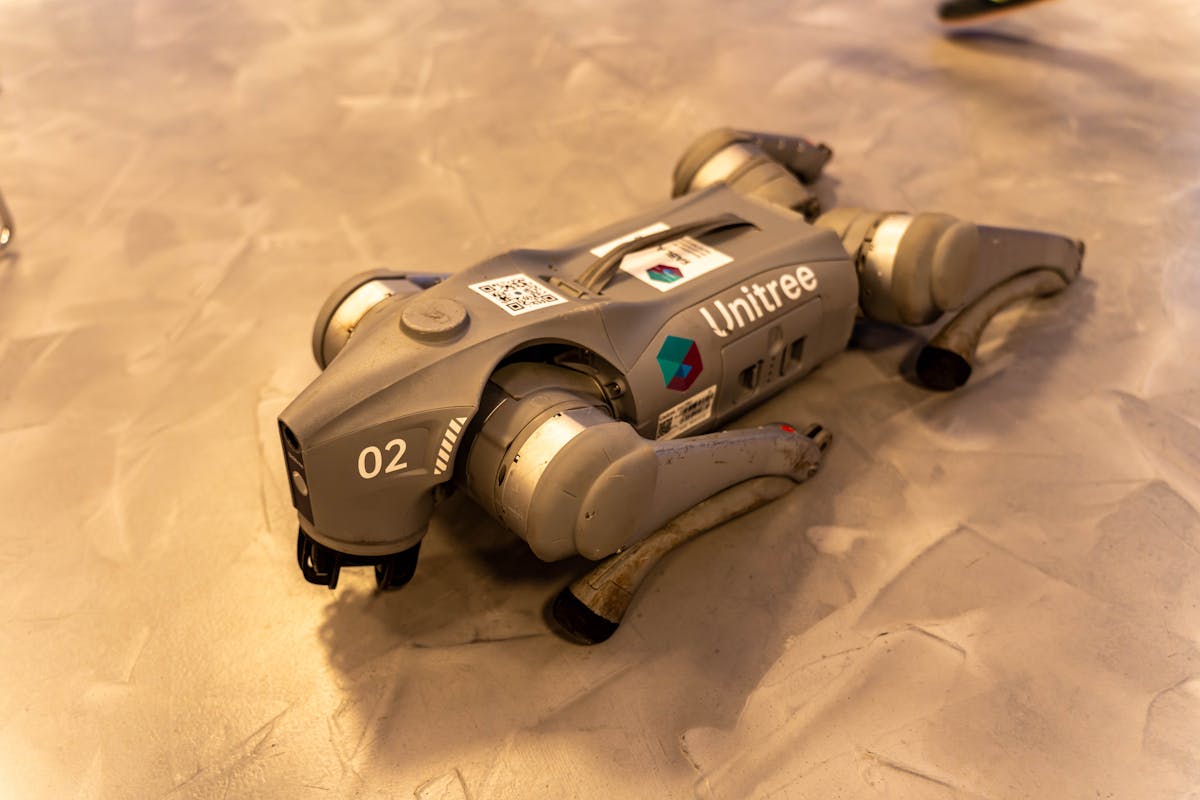
We’ve been living with the Unitree Go2 Air for five weeks — walking it through London parks, navigating it around our Surrey test home, and generally trying to work out whether a robot dog at £1,600 to £2,400 is a brilliant purchase or an expensive novelty. The short answer: it’s closer to brilliant than we expected. Here’s our full review.
Overview
The Unitree Go2 Air is the entry-level model in Unitree Robotics’ Go2 quadruped range. Unitree built its reputation on four-legged machines before expanding into humanoid robots like the R1 and G1, and the Go2 line represents years of refined quadruped engineering distilled into a consumer-friendly package.
Weighing approximately 15kg and standing roughly knee-height on an average adult, the Go2 Air is compact enough to share your living space without dominating it. It carries a payload of around 8kg, runs at a genuinely startling top speed of 18 km/h, and ships with a companion app that lets you control it, programme routines, and access a growing library of tricks and behaviours.
At its price point, the Go2 Air sits in a category that barely existed two years ago — a serious, capable quadruped robot priced for enthusiasts and early adopters rather than research institutions. For context on where robot dogs fit alongside humanoid options, our guide to humanoid and dog robots you can buy in the UK covers the full landscape.
Design and Build Quality
The Go2 Air looks like what it is: a piece of serious robotics engineering. There’s no attempt to disguise it as a plush toy or a pet. The body is a rigid composite shell in matte grey and black, roughly the proportions of a medium-sized dog but lower to the ground and wider through the shoulders. The legs use Unitree’s proprietary actuators — the same fundamental joint technology that powers their humanoid range — giving each limb a smooth, responsive quality that cheaper quadrupeds simply cannot match.
Build quality is excellent for the price. The outer panels are reinforced polycarbonate with rubberised sections protecting the joints and underbody. We deliberately ran the Go2 through wet grass, gravel paths, and light rain without issue. It isn’t IP-rated for submersion, but it handles the kind of weather you’d encounter on a typical British walk without complaint.
The sensor suite is genuinely impressive at this price tier. A super wide-angle 3D LiDAR system provides spatial mapping, complemented by an HD camera for visual recognition and obstacle detection. Together, these give the Go2 Air a level of environmental awareness that feels disproportionate to its cost — it perceives and reacts to obstacles, terrain changes, and moving objects with a confidence that consistently surprised us.
| Specification | Detail |
|---|---|
| Weight | ~15kg |
| Payload capacity | ~8kg |
| Battery | 8000mAh |
| Top speed | 18 km/h |
| Sensors | 3D LiDAR (super wide-angle), HD camera |
| Connectivity | Wi-Fi, Bluetooth, 4G (optional) |
| Charging | Proprietary charger |
| Notable abilities | Jump, sit, shake hands, dance, stretch, follow owner |
The 8000mAh battery provides roughly one to two hours of active use depending on intensity. Energetic outdoor sessions with lots of running drain it faster; gentle indoor patrols stretch it further. Charging from empty takes approximately 90 minutes. For a robot this active, battery life is adequate rather than generous — you’ll want to charge between outings.
Movement and Agility
This is where the Go2 Air earns its price. The movement is extraordinary.
Walking is smooth and adaptive. The Go2 adjusts its gait to surface conditions automatically — wooden floors, carpet, grass, gravel, and uneven paving all produced stable, confident locomotion without any input from us. Transitions between surfaces were handled within a stride, with no stumbling or hesitation.
Running is where things get genuinely exciting. The claimed 18 km/h top speed sounded optimistic until we timed it across our test garden. It’s real. For reference, 18 km/h is a solid running pace for most adults — watching a 15kg robot match it is startling. The acceleration is rapid and the directional changes at speed are sharp enough to make you flinch.
The trick repertoire is extensive and well-executed. The Go2 Air can jump over obstacles, sit on command, shake hands, stretch like a waking dog, and perform a range of dance routines that are genuinely entertaining rather than awkward. These aren’t gimmicks bolted onto a movement platform — they demonstrate the underlying control system’s sophistication. A robot that can jump cleanly can also handle unexpected terrain drops. One that dances smoothly has the balance control to recover from stumbles.
Fall recovery is strong. We nudged and pushed the Go2 from various angles on various surfaces, and it recovered from every reasonable disruption. Hard pushes on uneven ground occasionally produced a controlled sit rather than a recovery, but we never saw an uncontrolled fall. For a machine this lightweight, the stability is remarkable.
Stair handling deserves a specific mention. The Go2 Air navigates standard UK staircases — both up and down — with care and consistency. It’s not fast on stairs, but it’s reliable, which matters more.
AI and Autonomy
The Go2 Air’s intelligence sits at a practical level rather than a conversational one. It won’t hold a discussion with you, but it understands its environment and responds to it with genuine competence.
The follow-owner mode is the standout autonomous feature. Using a combination of visual tracking and LiDAR, the Go2 follows a designated person through complex environments — around furniture, through doorways, across roads. We tested this extensively during outdoor walks and the tracking was impressively tenacious. It maintained a consistent following distance even when we changed pace suddenly, turned corners, and navigated through groups of (very curious) pedestrians.
Obstacle avoidance operates continuously and reliably. The LiDAR and camera fusion means the Go2 detects objects well before reaching them and plans smooth paths around them. In our cluttered test home, it navigated confidently without bumping furniture, even in rooms it hadn’t previously mapped.
Autonomous patrol modes let you define routes through your home for the Go2 to follow on a schedule. Combined with the HD camera feed streamed to your phone, this creates a capable mobile security system that can check rooms, navigate around obstacles, and alert you to unexpected movement. It’s not a replacement for a dedicated alarm system, but the flexibility of a camera that can walk to any room on demand is genuinely useful.
The AI layer also handles terrain adaptation. The Go2 analyses surface conditions in real time and adjusts its movement parameters accordingly — shorter strides on slippery surfaces, wider stance on uneven ground, slower speeds in tight spaces. This happens automatically and it works well.
Companion App
The Unitree companion app (available on iOS and Android) is your primary interface with the Go2 Air, and it’s more capable than we expected.
Basic controls are intuitive — a virtual joystick for movement, quick-access buttons for tricks and behaviours, and a live camera feed. The interface is clean and responsive, with minimal lag between input and robot response over a local Wi-Fi connection.
Where the app gets interesting is in its programming capabilities. A visual programming environment lets you create custom behaviour sequences — chain together movements, tricks, pauses, and sensor-triggered actions into routines that the Go2 executes autonomously. It’s accessible enough for a motivated teenager and powerful enough for a hobbyist developer to build genuinely complex behaviours. For those who prefer traditional coding, Unitree also provides SDK access for Python-based programming.
The app handles firmware updates, diagnostics, battery monitoring, and configuration. Updates arrived twice during our five-week test period, each improving responsiveness and adding minor features. Unitree’s development pace on the software side is commendable — the robot genuinely improves over time.
One frustration: the app occasionally loses connection during Bluetooth handoff situations, requiring a manual reconnect. It happened perhaps once every three or four sessions. Not a dealbreaker, but noticeable.
Indoor vs Outdoor Use
We tested the Go2 Air extensively in both environments, and it performs well in each — though with different strengths.
Indoors, the Go2 excels as a patrol and companion robot. Its navigation is confident in furnished rooms, it handles doorways and corridors without issue, and its noise level is low enough for evening use without disturbing anyone. The camera feed and patrol modes make it a genuinely useful home monitoring tool. At 15kg and knee-height, it’s small enough not to feel imposing in domestic spaces.
Outdoors, it transforms into something more dramatic. The speed, agility, and terrain handling come alive on grass, paths, and open ground. Following mode turns outdoor walks into genuinely enjoyable experiences — it trots alongside you like an athletic, slightly mechanical dog, and the reactions from passersby range from delighted to astonished. It handles typical park terrain — grass, gravel, gentle slopes, tree roots — without difficulty.
Limitations exist in both settings. Indoors, the battery life means you can’t run it as a continuous security patrol without scheduling charging breaks. Outdoors, wet weather beyond light rain is best avoided, and the robot draws enough attention that you’ll struggle to walk anywhere quickly. That second point is worth considering seriously — every outdoor outing with the Go2 involves stopping for questions from curious strangers.
Go2 Air vs Pro vs EDU
Unitree offers the Go2 in three configurations. Understanding the differences matters because the price jumps are significant.
| Feature | Go2 Air (£1,600–£2,400) | Go2 Pro (~£4,999) | Go2 EDU (~£7,500+) |
|---|---|---|---|
| LiDAR | Super wide-angle 3D | Enhanced 3D LiDAR | Enhanced 3D LiDAR |
| Camera | HD | HD + thermal | HD + thermal + stereo |
| Computing | Standard | Enhanced onboard | Full research-grade |
| SDK access | Basic + app programming | Full SDK | Full SDK + ROS2 |
| Payload | ~8kg | ~8kg | ~8kg |
| Speed | 18 km/h | 18 km/h | 18 km/h |
| Target user | Enthusiast/consumer | Developer/prosumer | Researcher/institution |
The Go2 Air is the right choice for most UK buyers. It delivers the core Go2 experience — the movement, the tricks, the companion features — without the enhanced computing and sensor packages that primarily benefit developers and researchers.
The Go2 Pro adds thermal imaging, enhanced onboard processing, and full SDK access. If you’re a developer planning to build custom applications on the platform, the Pro justifies its premium. For everyone else, the Air does everything you’ll need.
The Go2 EDU is an institutional product. Research labs, universities, and robotics programmes benefit from its full ROS2 integration and expanded sensor suite. It’s not a consumer purchase, and at more than triple the Air’s price, it shouldn’t be.
Who Is This For
Buy it if:
- You want the most capable consumer robot dog available in the UK
- You’re fascinated by robotics and want a platform you can grow with
- You want a mobile home security and monitoring system with genuine flexibility
- You enjoy outdoor walks and want a robotic companion that keeps pace
- You’re a developer or student wanting to learn quadruped programming
- You want something that genuinely impresses everyone who sees it
Don’t buy it if:
- You expect a replacement for a real pet — it doesn’t provide warmth or emotional reciprocity
- You need more than two hours of continuous active use
- You’re uncomfortable with occasional firmware updates and app reconnections
- You want something that operates entirely autonomously without any learning curve
- Your budget is tight — at £1,600 to £2,400, this is still a significant investment
The Go2 Air occupies a unique space in consumer robotics. It’s not a toy, it’s not a research tool, and it’s not a pet replacement. It’s a genuinely capable robotic platform that happens to be shaped like a dog and priced within reach of enthusiast buyers. People who understand that distinction tend to love it.
For a broader look at what’s available across the robotics market, our Boston Dynamics alternatives guide compares the Go2 against other quadruped and humanoid options, and our humanoid robot price guide puts it in context against the wider UK market.
UK Availability and Pricing
The Unitree Go2 Air is available to UK buyers through several channels. The most straightforward option for most buyers is Amazon UK, where authorised sellers list the Go2 Air with Prime delivery and standard Amazon buyer protection.
Prices on Amazon UK currently range from £1,600 to £2,400 depending on the seller, included accessories, and whether the listing bundles additional warranty coverage. We recommend checking seller ratings carefully and confirming the listing is for the Air model specifically — some listings bundle Air and Pro options on the same page.
Alternative purchasing routes include ordering directly from Unitree’s global store (typically the cheapest option but requires handling import logistics yourself) and European distributors who ship to the UK with duties pre-paid. For a complete guide to purchasing robots in the UK, including import duty and VAT considerations, see our where to buy humanoid robots in the UK guide and our importing robots guide.
Our Verdict
The Unitree Go2 Air is the best consumer robot dog you can buy in the UK in 2026. Nothing else at this price combines the movement quality, sensor capability, and genuine usability that the Go2 delivers. It’s fast, agile, intelligent, and — importantly — it’s fun.
Its limitations are honest ones. Battery life could be longer. The app has occasional connectivity hiccups. It draws so much attention outdoors that quick errands become extended demonstrations. And it is, ultimately, a robot — it doesn’t replace the companionship of a real animal, nor does it pretend to.
But what it does, it does brilliantly. The locomotion is world-class. The autonomy is practical and reliable. The companion app offers genuine depth for those who want to explore it. And the platform has real longevity — regular software updates and SDK access mean the Go2 you buy today will be more capable in six months than it is now.
Scores:
| Category | Rating |
|---|---|
| Movement and agility | 9.5/10 |
| Build quality | 8.5/10 |
| AI and autonomy | 8/10 |
| Companion app | 7.5/10 |
| Battery life | 6.5/10 |
| Value for money | 9/10 |
| Overall | 8.5/10 |
Bottom line: At £1,600 to £2,400, the Unitree Go2 Air delivers a quadruped robotics experience that was exclusive to research labs just a few years ago. It moves like nothing else in its class, it’s built to last, and it’s genuinely thrilling to use. We recommend it confidently to anyone who understands what they’re buying — not a pet, but something arguably more interesting.
Buy the Unitree Go2 Air on Amazon UK
Prices quoted are estimates as of May 2026. Amazon pricing fluctuates by seller and availability. See our complete price guide for the latest calculations.